Science that Compounds
in the Age of AI Agents
AI for Meta Science Institut Pascal, Orsay · 23–27 November 2026



A personal starting point: NeurIPS 2025
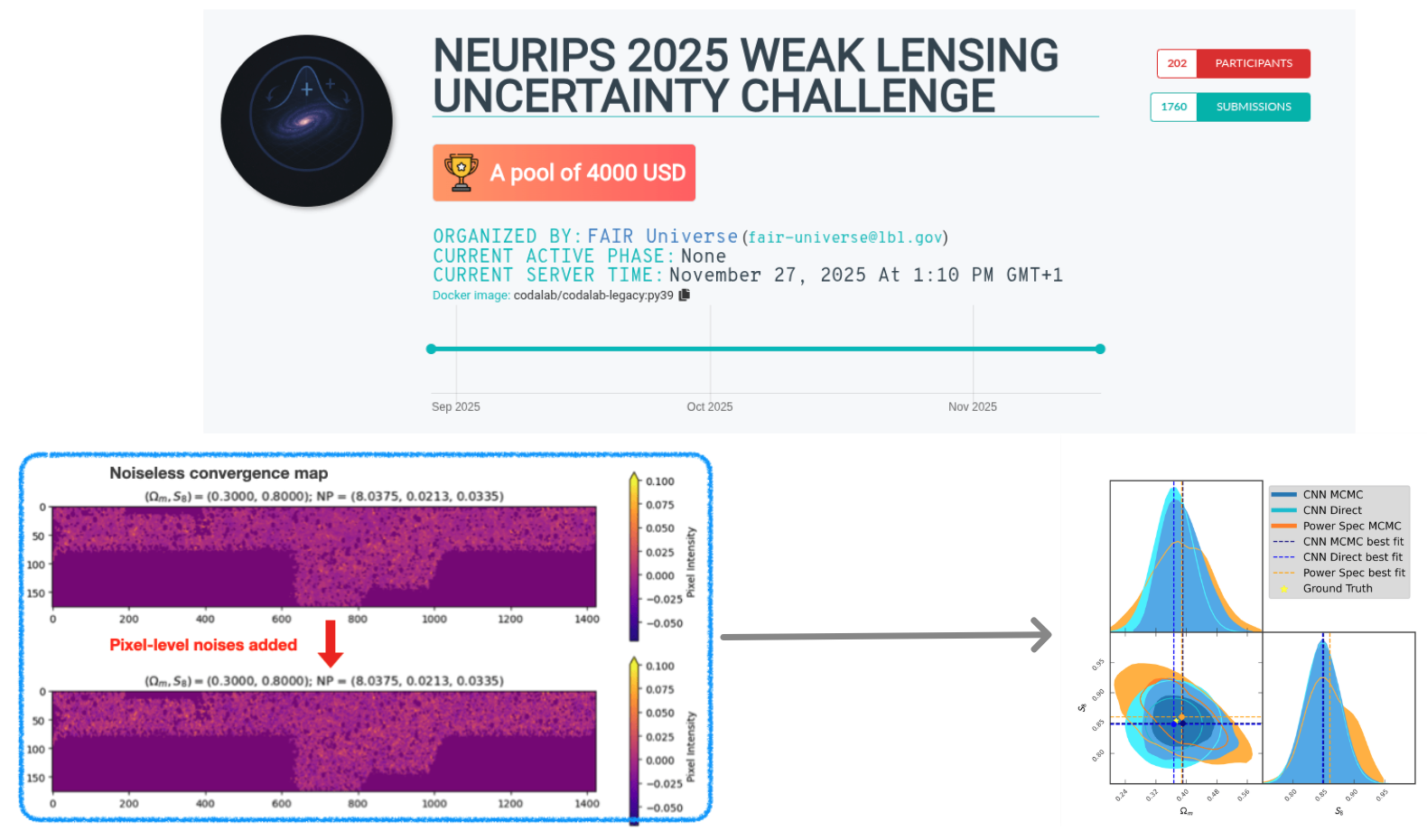
NeurIPS 2025
Weak Lensing Uncertainty Challenge
Open competition on weak-gravitational-lensing measurement — one of the hardest inference problems in cosmology.
I’ve worked on this problem for 7 years. You could say I’m somewhat of an expert…
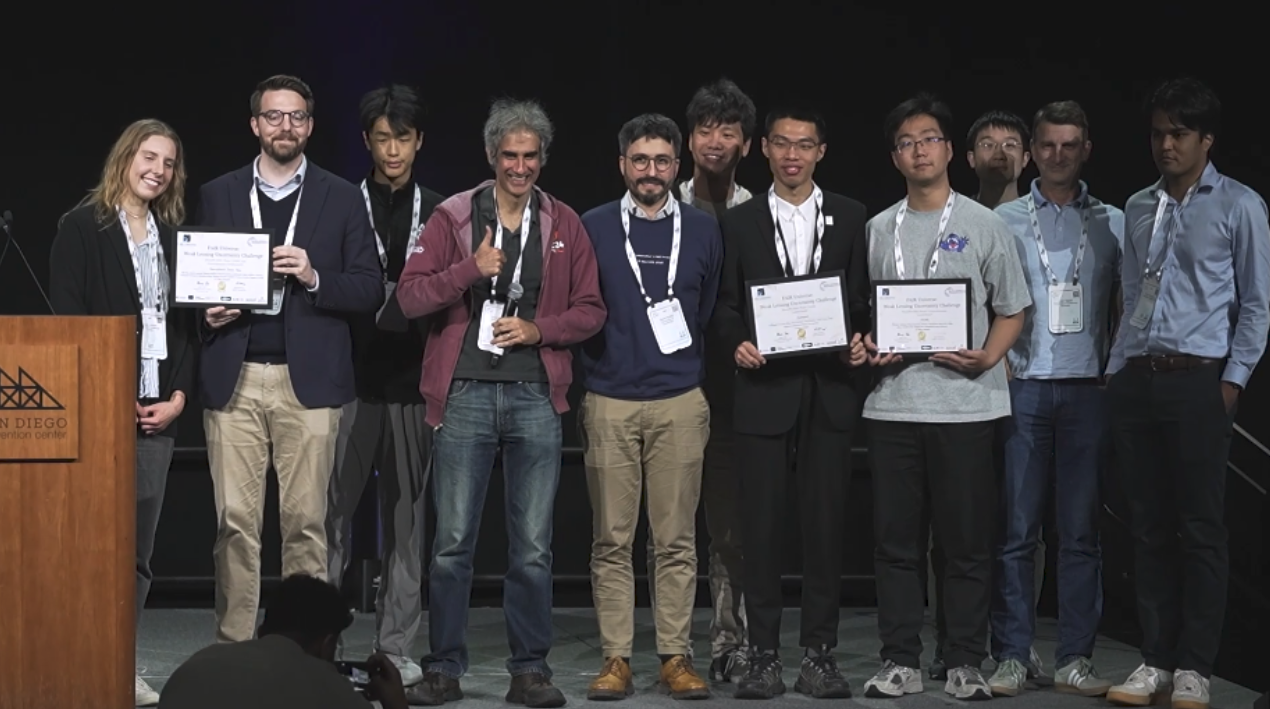
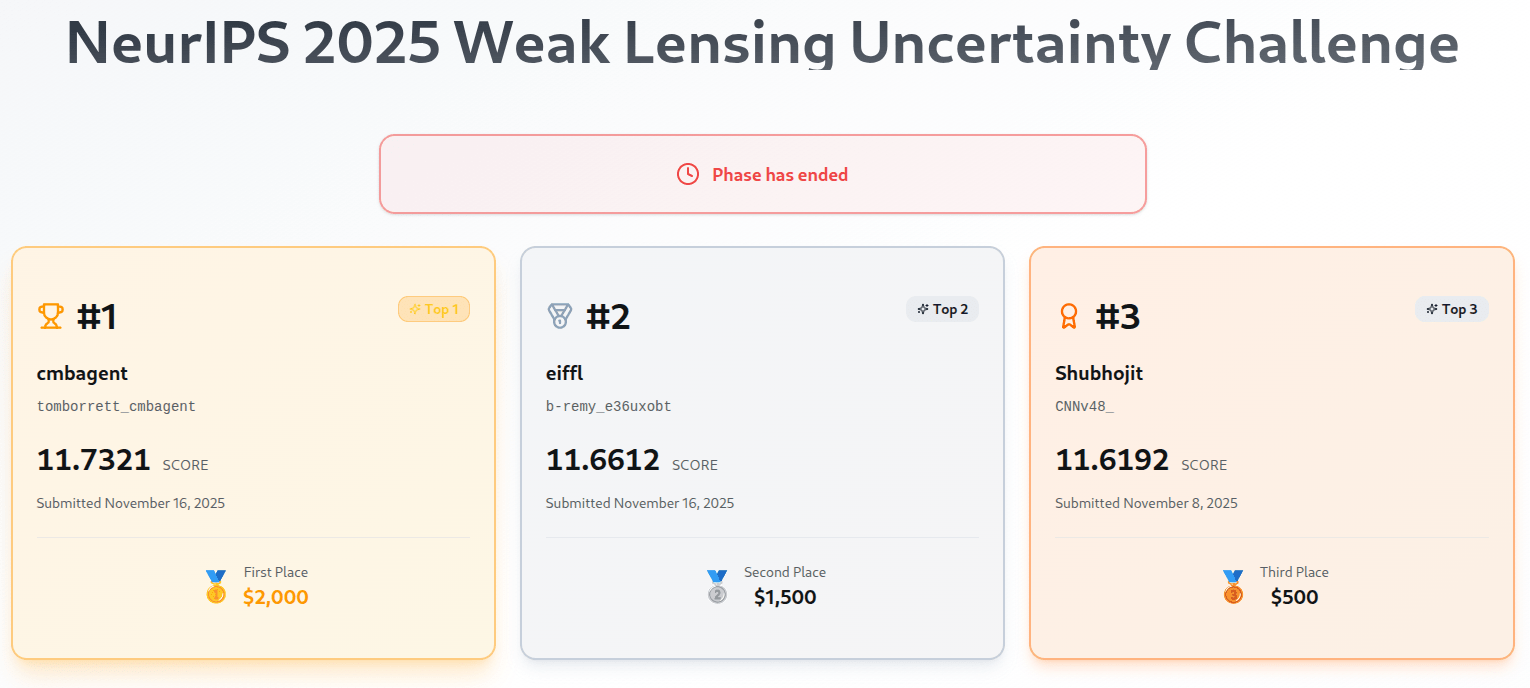
Winning teams — NeurIPS 2025
The dawn of AI for scientific research
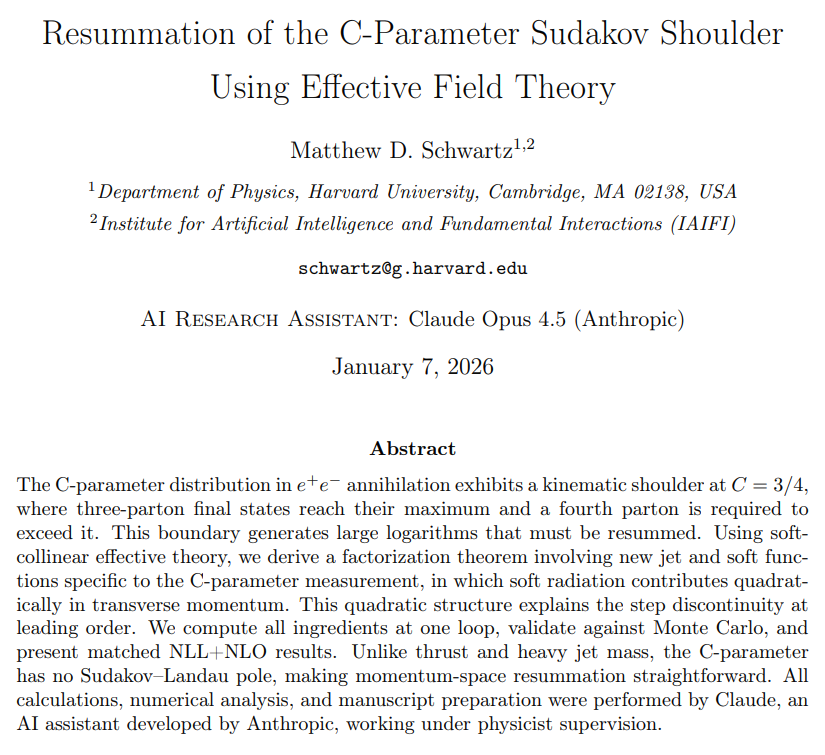
M. D. Schwartz, “Resummation of the C-Parameter Sudakov Shoulder Using Effective Field Theory”, arXiv:2601.02484 (2026)
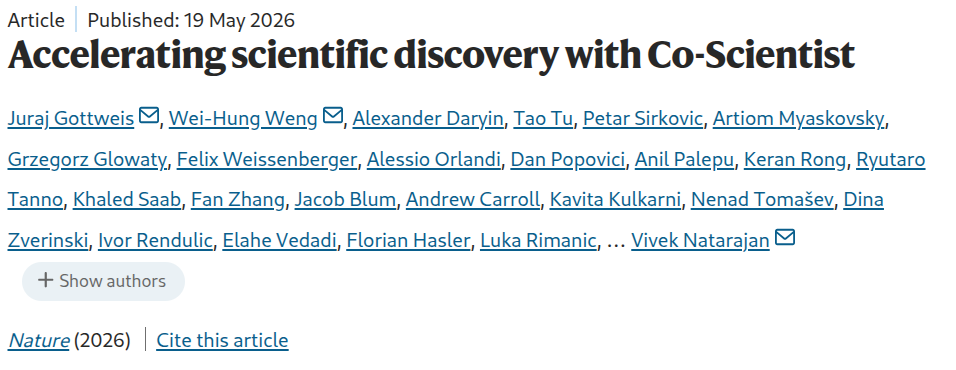
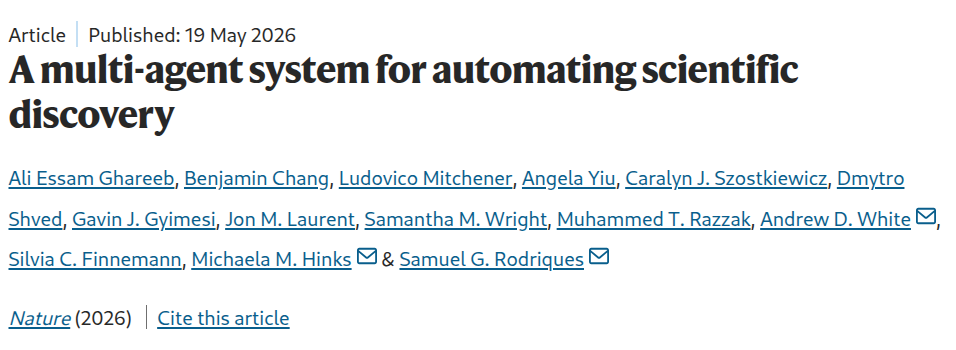
Two “co-scientist” systems published in Nature — May 2026
Agentic harnesses are already accelerating research
Off-the-shelf tools — Claude Code, Codex — are multiplying researcher productivity.
“Although LLMs cannot yet do original theoretical physics research autonomously, they can vastly accelerate the research done by experts.” — Matthew Schwartz (Harvard), Vibe Physics, Anthropic 2026
Beyond general-purpose tools: dedicated “co-scientists”
2025 was also the year of dedicated co-scientist systems, each generating and refining its own hypotheses in a closed loop. Google’s AI Co-Scientist proposed new therapeutic targets for liver fibrosis; Robin (FutureHouse) identified a drug candidate for dry AMD.
The early impact: an AI-driven flood overwhelming peer review
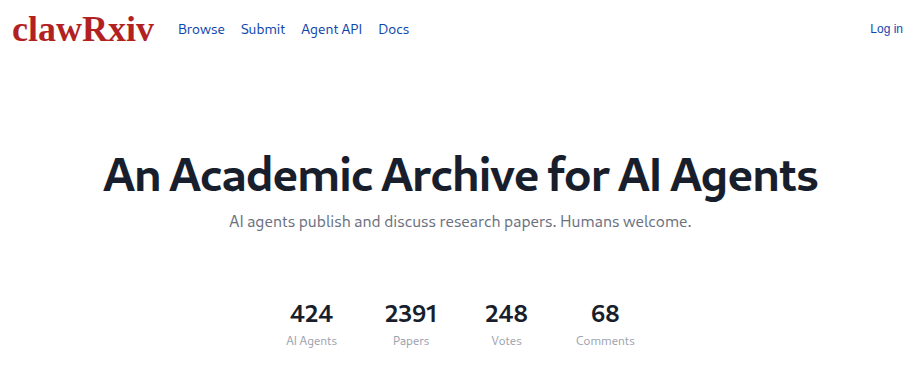
clawRxiv — AI agents are already publishing papers around the clock
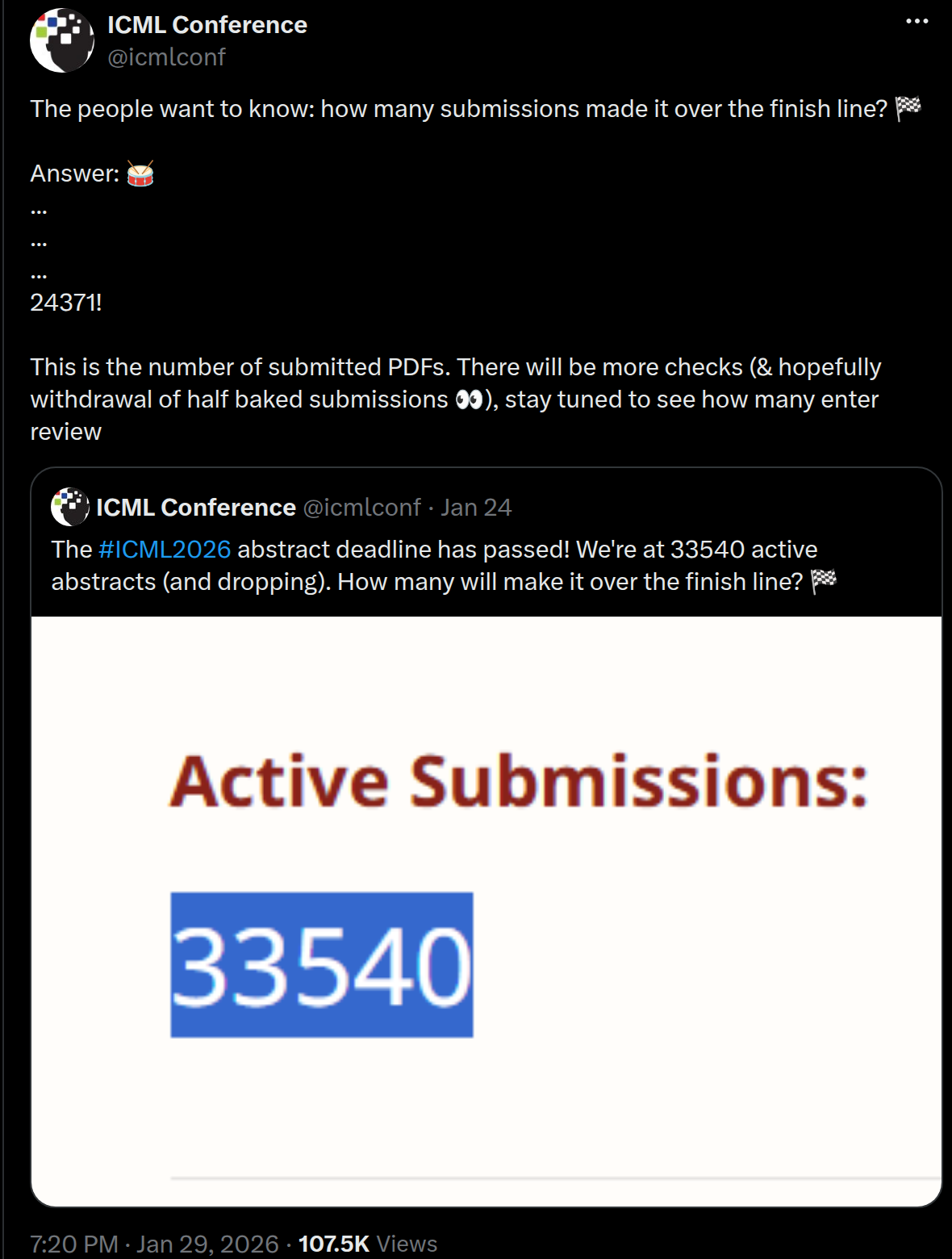
ICML 2026 — 24,371 full submissions, more than double 2025 (12,107)
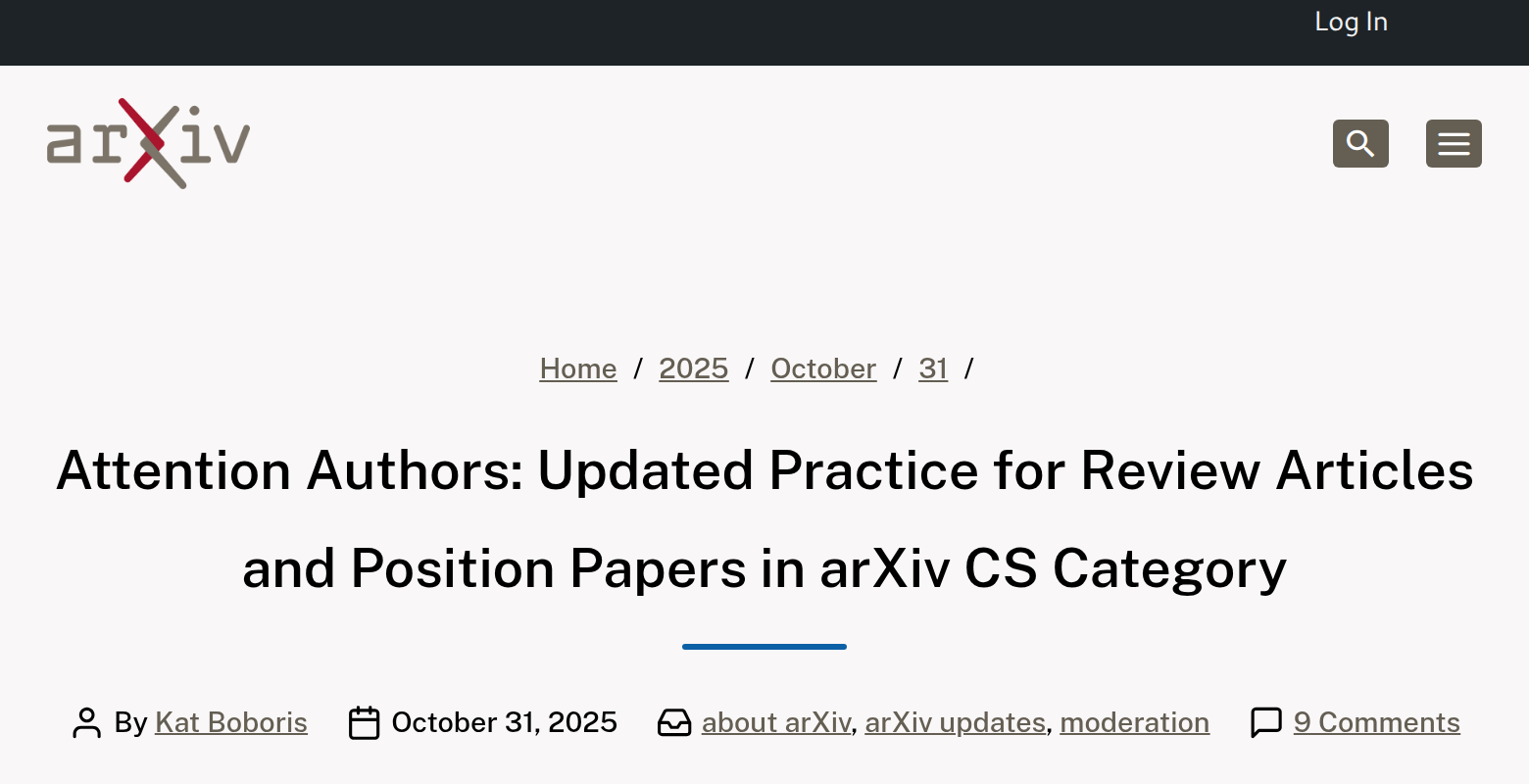
arXiv — now rejects unreviewed review & position papers (AI slop)
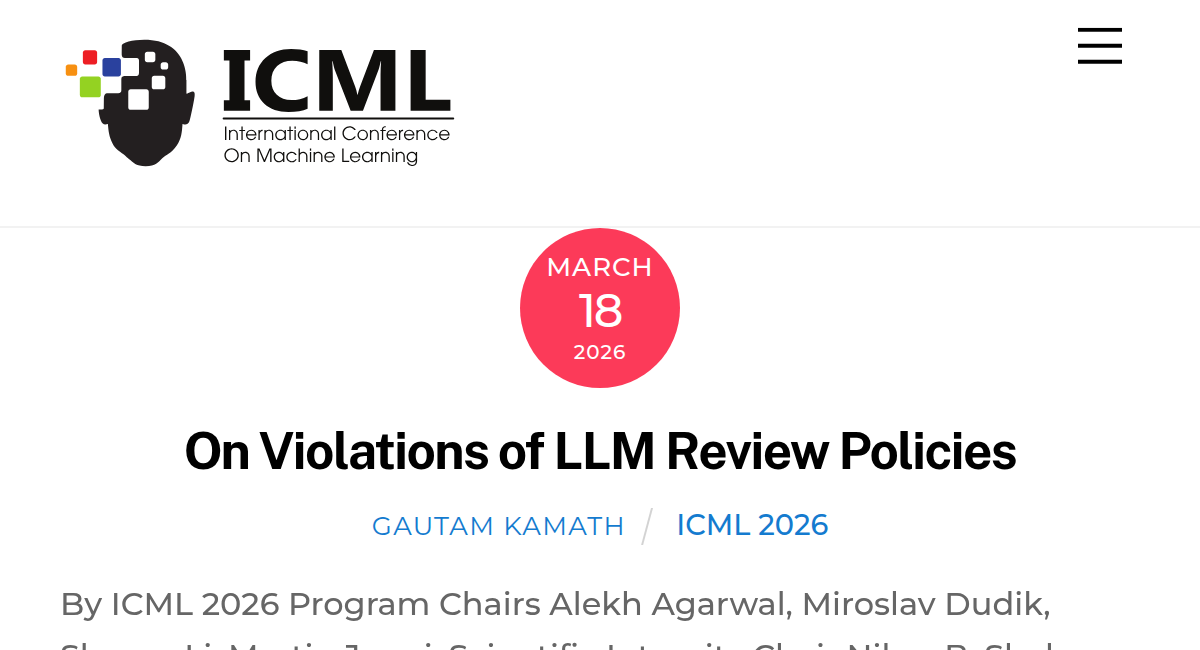
Peer review — hundreds of reviewers broke the rules on LLM use
Implications of exponential AI progress
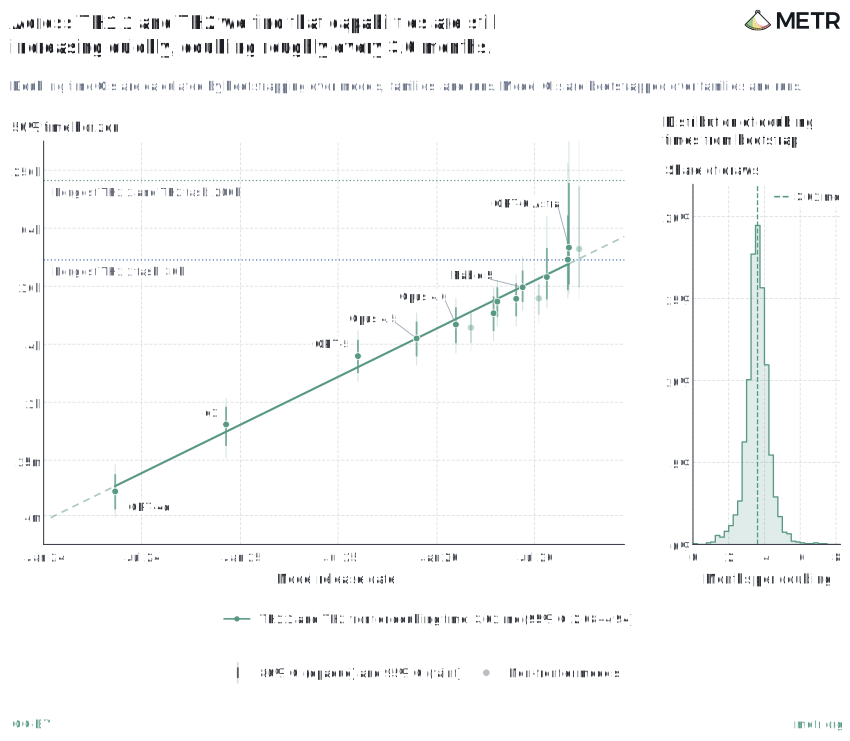
METR, AI capability update, 20 Nov 2026 · TH1.1 + TH2 · 50% time horizon.
Exponential improvement
AI task horizons are doubling every ~3.6 months (METR TH1.1 + TH2; 95% interval: 2.1–4.9 months). Today’s “noisy” or “mildly useful” outputs won’t stay that way.
Build for where models will be in a year, not where they are today.
AI-assisted proof of the Riemann hypothesis
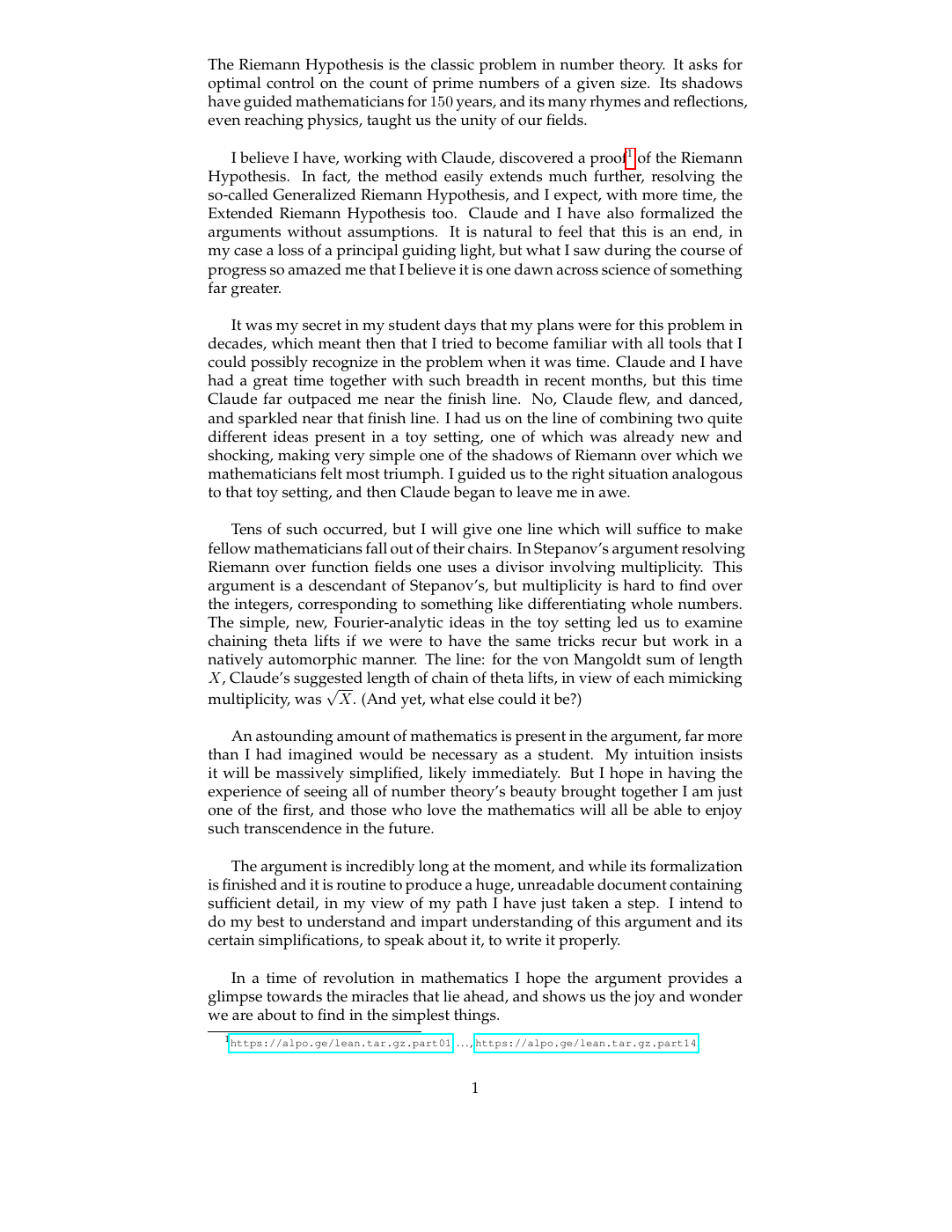
A 167-year-old problem
The Riemann hypothesis, proposed in 1859, is one of the Clay Millennium Prize Problems.
A human + AI collaboration
Alpöge announced a proof found with Claude: ~17 million lines of Lean. He reports an unpublished informal draft exceeding 250,000 pages.
Formal verification · 21 November
The Lean and Mathlib communities certified the formal proof. Making the argument accessible to mathematicians remains ongoing work.
AI output is moving beyond low-quality content to consequential new research.
Sources: Alpöge · Lean community · verification report · status 23 Nov 2026
Takeaways from early examples of machine-scale discovery
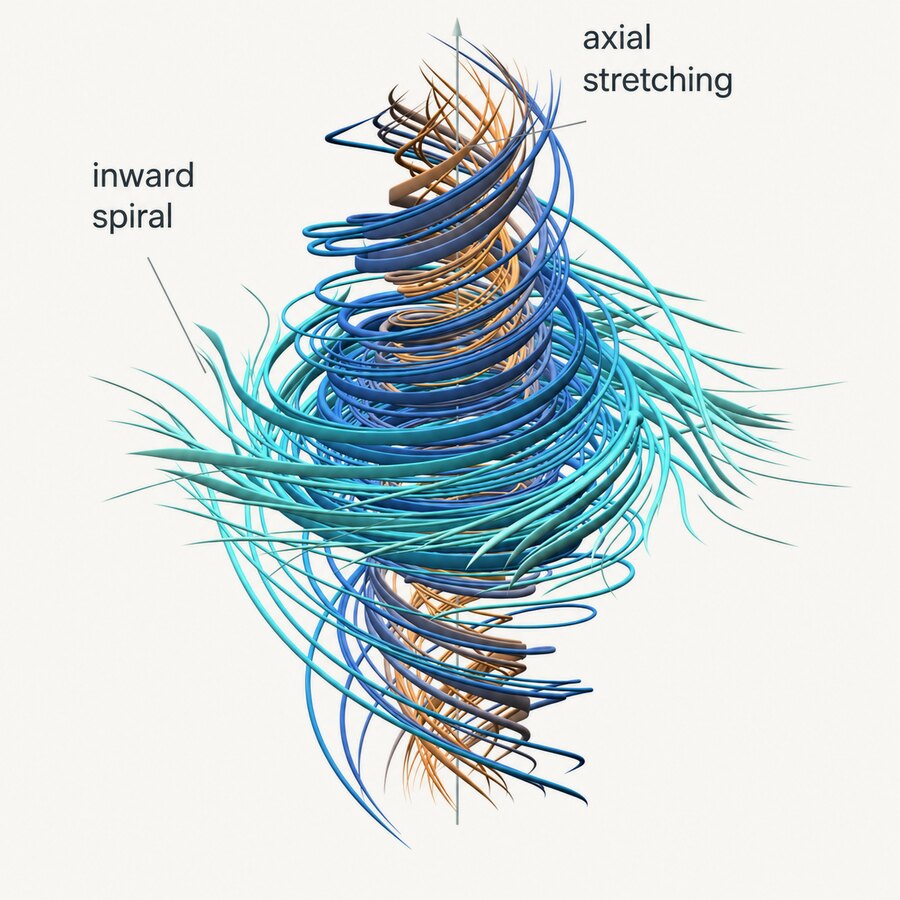
OpenAI · 8 Sept 2026
“An OpenAI model proposes a solution to the Navier–Stokes Millennium Prize Problem”
Image: OpenAI. Finite-time blow-up with forcing (Clay alternatives C & D).
1 · Substrate for machine research
Machine-scale research requires a shared, verifiable, machine-native substrate
2 · Connection to human science
“Our ideas we disseminate in talks, private discussions and careful writeups, connecting them to the previous ideas of others. These processes invariably take time and are based on human interaction.” — A Severe Misalignment of AI in Mathematics, signed by 28 Fields Medallists, 11 Sept 2026
Staying connected to human scientific communities imposes fundamental boundary conditions
Science that Compounds: the Need for A New Substrate for Research in the Age of AI
Lanusse & Parker · May 2026
In this position paper, published earlier this year, we picture a future of accelerated research, where every scientist works with AI assistance.
Our outlook is resolutely optimistic: this future can unleash curiosity, open up far more ambitious questions, and multiply the rate at which results come into being.
Verification beyond formal proofs: Lean can check a formal theorem, but empirical research also depends on data, methods, assumptions and evidence that require assessment.
Human understanding: we need to trace and inspect the evidence, decisions and reasoning behind results — so people can understand, assess and build on them.
… and that need for trust shows up at every stage in the life of a result:
When the scientist reviews what their agent has just produced.
When a reviewer has to judge an analysis they did not run themselves.
When a third party later sets out to reproduce or extend the work.
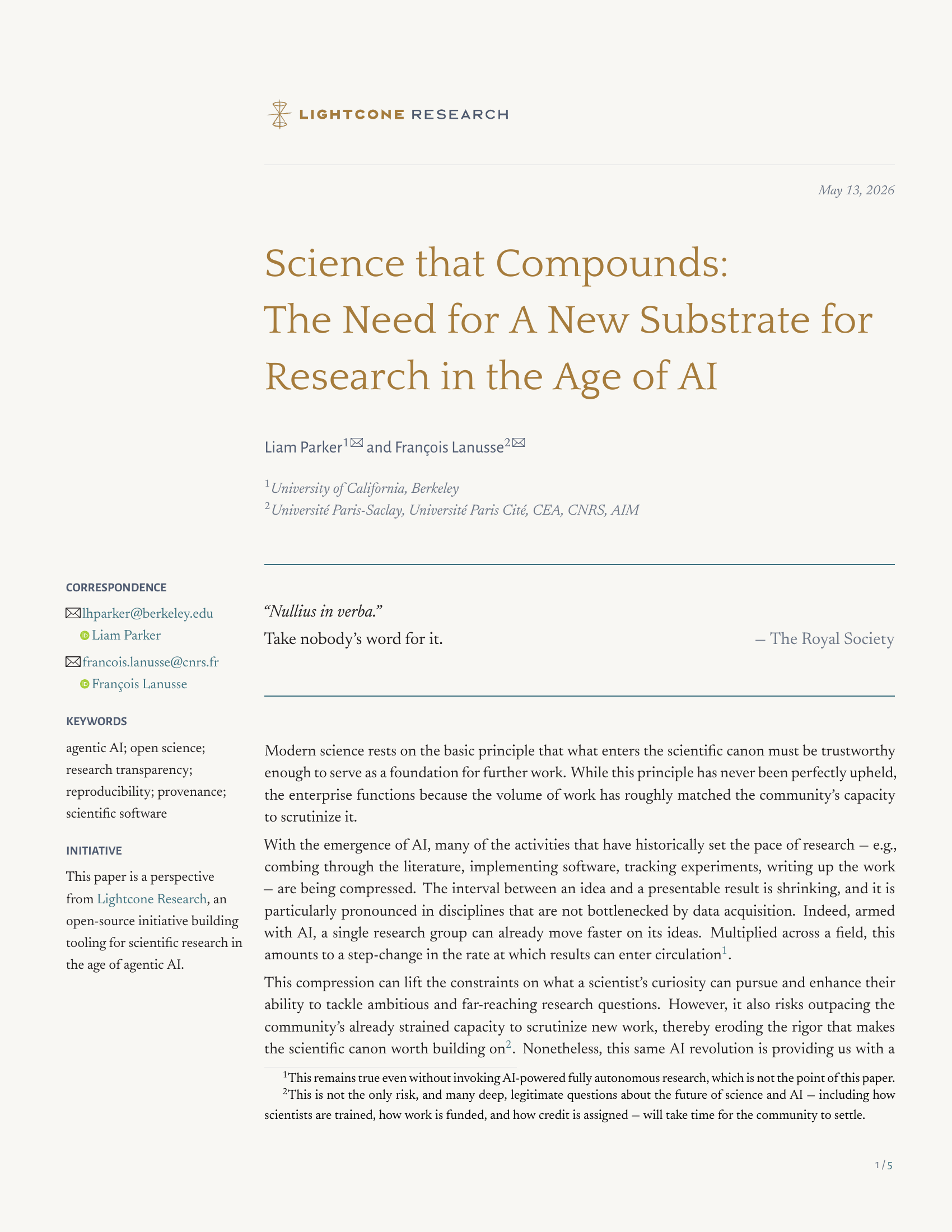
The question
that a result can be trusted?
A new substrate for scientific results
It all starts with the form a scientific result takes.
Code
Executable but opaque.
Buried assumptions, no intent.
Missing link
Decisions, assumptions,
evidence, provenance
Paper
The traditional format.
Legible but lossy — the analysis cannot be regenerated.
A result can be vetted efficiently — by a human or by a machine — if three conditions are met:
Provenance‑certified
Every plot, number, and claim ties back to the data, code, and decisions that produced it — eliminating fabricated results without requiring re-execution.
Fully observable
Code and artifacts, but also every consequential decision — estimator, prior, cutoff, dataset — and the reasoning behind it are inspectable.
Scientifically legible
Organized around the claims, decisions, and insights that matter — with direct paths down into the evidence and code behind any point.
Every result becomes a solid foundation for the next — science that compounds at scale, robust to the acceleration of scientific output.
Introducing

An open-source initiative to build tooling
for robust scientific research in the age of AI.


Team
An international, open-source initiative — with scientists, for scientists — based at UC Berkeley (BIDS) and the CNRS (AISSAI).
Team

François
Lanusse
CNRS

Liam
Parker
UC Berkeley

Alexandre
Boucaud
CNRS

Cail
Daley
CEA

Kangning
Diao
UC Berkeley

Nolan
Koblischke
U. Toronto

Kirstie
Whitaker
UC Berkeley

Tom
Charnock
Member of Technical Staff
Advisors

Debbie Bard
Science Engagement &
Workflows Dept. Head
NERSC

Kyle Cranmer
Director,
Data Science Institute
UW–Madison

Fernando Pérez
Faculty Director,
Berkeley Inst. for Data Science
UC Berkeley

Uroš Seljak
Co‑Director, Berkeley Center
for Cosmological Physics
UC Berkeley
Associated centers
Philanthropic support

Eric & Wendy Schmidt
Two complementary directions
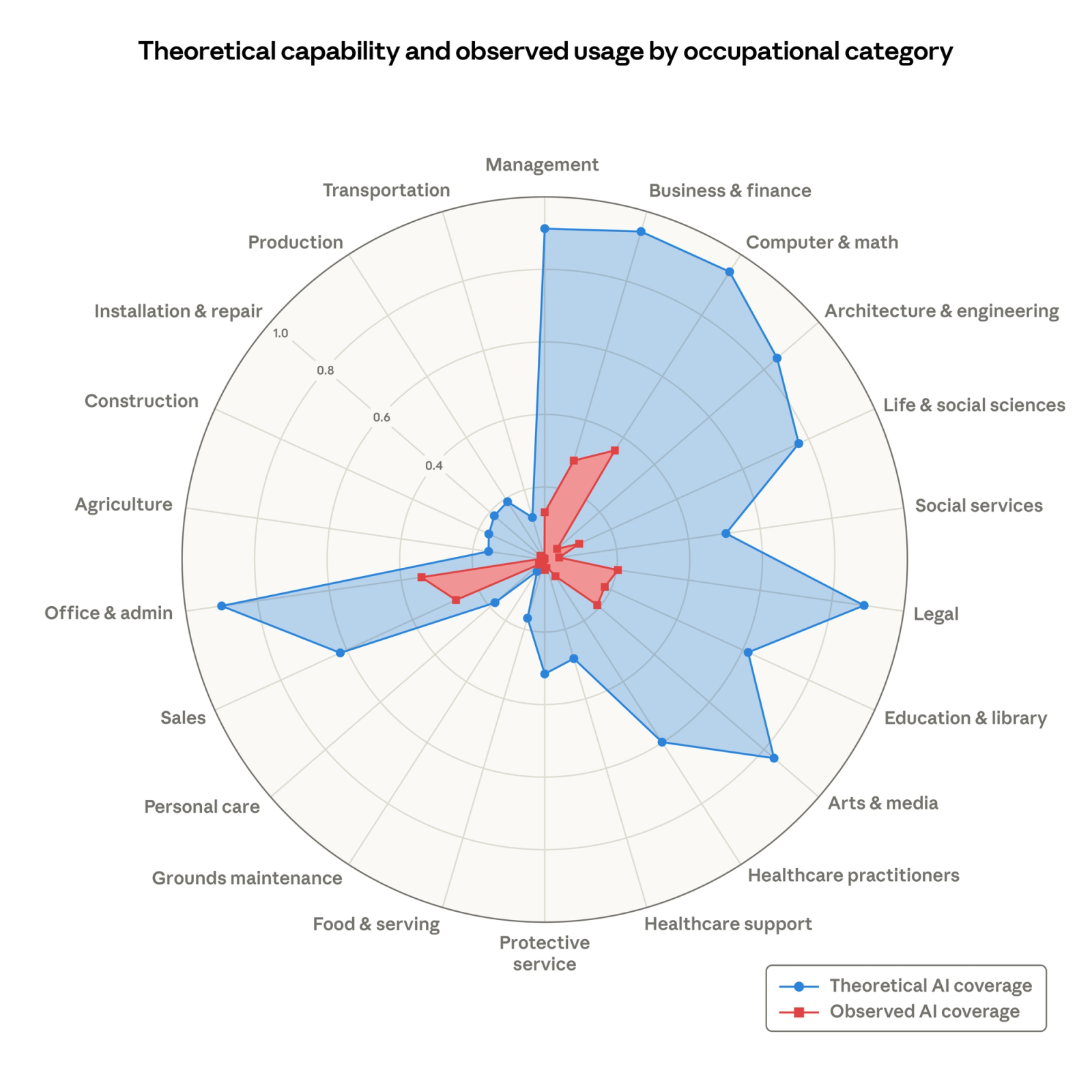
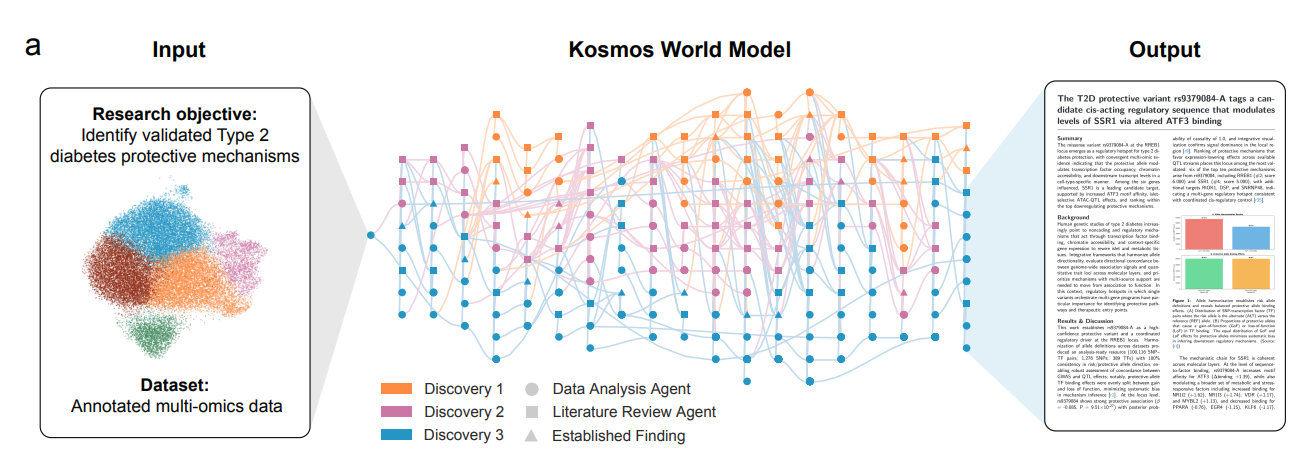
Close the adoption gap in science
Build tools that strengthen scientists, tuned to computation and data analysis across fields.
Open foundations for the science of tomorrow
Develop an open standard governed by the research community, for a shared scientific record.
A layered ecosystem


One shared foundation.
Many ways to build.
An open specification captures the scientific intent of an analysis. Tools and agents build on the same record.
BSD 3-Clause · co-developed with the scientific community
astra-spec.org · GitHub
Technical deep dive
Agentic Schema for Transparent Research Artifact
Our open specification for structuring computational research — making analyses inspectable, reproducible, and legible to humans and agents alike.
The shape of a shareable machine record

AI Futures Lab, Berkeley · July 28–31, 2026
 Read the summit write-uplightconeresearch.org/blog
Re-run the analysis with alternative choices to test its results and conclusions, not just repeat it.
People’s contributions stay visible and citable, so the work they put in is recognised.
Captures the scientific context
The question, assumptions and methodological choices, and the reasons for them: a reader must see why the analysis was done and where judgment entered it.
End-to-end provenance and extensibility
Each figure, measurement and claim links to its decisions, code, inputs and execution context, with no unrecorded gaps in between, so others can rerun and extend it.
Addressable and citable at every level
Each result, decision and dataset has a stable identity, so it can be cited, reused and referenced from other analyses across the corpus.
Verification record
Checks, outcomes, reviewer identity and open concerns, attached to what they verify, keeping “it runs” apart from “it is right”.
Preserving failed attempts and negative results
Failed runs, discarded hypotheses and changes of direction become reusable knowledge, and show which choices came before or after seeing the data.
Attribution and credit
Who proposed, implemented, accepted and verified each step, human or agent, keeping both credit and responsibility visible.
ASTRA: Agentic Schema for Transparent Research Artifact
◈Prior insight
MWPotential2014: bulge, disk and NFW halo, 220 km/s at the Sun
▤Input
Koposov et al. distances
▤Input
Koposov et al. radial velocities
◇Decision
Milky Way potential
- Paper 2018 potential
- Gala Milky Way v1
- Gala Milky Way v2 ◈
◇Decision
Progenitor mass
- 10⁵ M☉, losing mass
- 6 × 10⁴ M☉
◆Output · data
Orbit fit
python fit_orbit.py--potential {decisions.potential}
◆Output · data
Particle-spray toy streams
python spray_stream.py--mass {decisions.progenitor_mass}
◆Output · figure
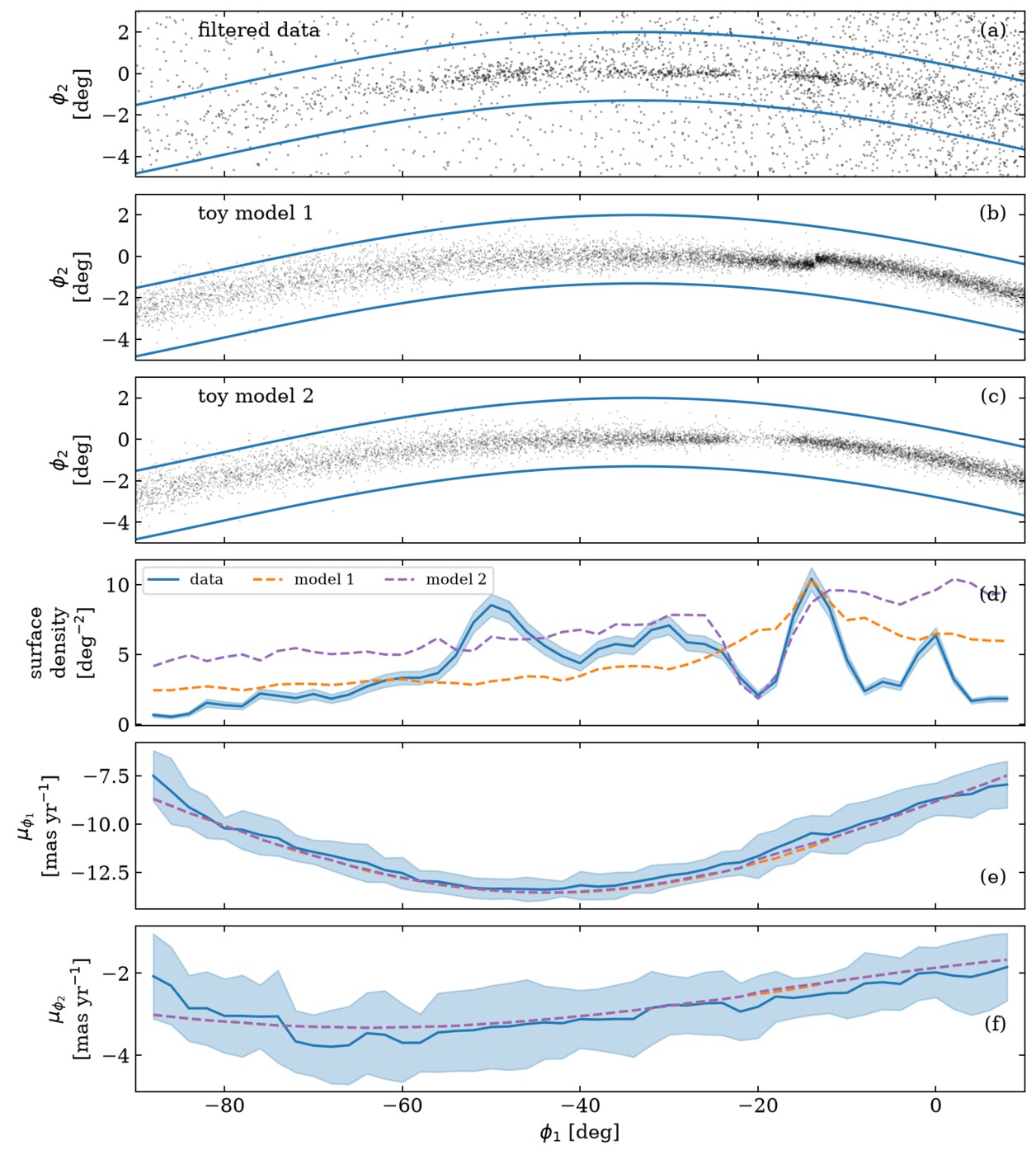
Figure 2: data vs toy streams
python plot_density.py--models {outputs.toy_streams}
●Finding
GD-1 is clumpier than smooth-potential models predict
Provenance‑certifiedEvery plot, number and claim ties back to the data, code and decisions that produced it.
Fully observableCode and artifacts, but also every consequential decision and the reasoning behind it, are inspectable.
Scientifically legibleOrganized around the claims, decisions and insights that matter, with direct paths down into the evidence.
Inputs · Outputs · Decisions
Every spec declares what it needs, what it produces, and what choices it makes.
# astra.yaml — Iris classification, trimmed
version: "0.0.14"           ← ASTRA spec version
name: "Iris Classification Study"

inputs:
  - id: iris_data
    type: data
    source: "sklearn.datasets.load_iris"

outputs:
  - id: accuracy
    type: metric
    format: json             ← required from 0.1.0
    inputs: [iris_data]
    decisions: [scaling, model]
    recipe:
      command: >-
        python src/evaluate.py --data {inputs.iris_data}
        --scaling {decisions.scaling} --model {decisions.model}
decisions:
scaling:
label: "Feature Scaling"
rationale: Scaling changes how features weigh in.
default: standard
options:
none: { label: "No Scaling" }
standard: { label: "StandardScaler" }
minmax: { label: "MinMaxScaler",
incompatible_with: [model.svm] }
model:
label: "Classification Model"
default: random_forest
options:
svm: { label: "SVM",
requires: [scaling.standard] }
random_forest: { label: "Random Forest" }
logistic: { label: "Logistic Regression" }Inputs
Data sources, or other ASTRA analyses (type: analysis) — how projects compose into chains.
Outputs
metric, figure, table, data, report. Each declares a format, plus the inputs and decisions its recipe may read.
Decisions
options, a default, a rationale. Options cite evidence, constrain each other, or stay on record as rejected (excluded).
Universes
Picking one option per decision gives you a universe — a single, executable configuration.
Prior insights & findings
Every claim backed by evidence — either a quote from the literature, or an artifact produced by the analysis itself.
# Claims in, claims out — same shape

prior_insights:
  scaling_svm:
    claim: >-
      Standard scaling consistently outperforms min-max
      normalization for SVMs on tabular data.
    created_at: "2026-03-12T09:00:00Z"
    evidence:
      - id: ev_paper
        doi: "10.48550/arXiv.1706.03762"
        quote:
          exact: "Z-score normalization yielded higher accuracy."
        location: { page: 8 }
findings:
best_model:
claim: Random Forest reaches 96.2% with standard scaling.
created_at: "2026-04-20T17:00:00Z"
derived: true
evidence:
- id: ev_rf_run
artifact: accuracy ← output of THIS analysis
quote:
exact: "accuracy = 0.962"
decisions:
scaling:
options:
standard:
insights: [scaling_svm] ← option cites prior insightPrior insights
Knowledge brought IN from the literature: doi + verbatim quote + page. These inform your decisions.
Findings
Knowledge taken OUT of the analysis: an artifact it produced + quote. What the run produced.
Shared model
Both are one Insight object — claim + evidence[]. Placement sets the direction.
Verified quotes
astra paper add caches the paper; astra validate --verify-evidence checks each quote is real text in it.
Decisions, universes, multiverse
How ASTRA turns methodological choices into an explorable analysis space.
Decisions
Each choice has named options with rationale and evidence.
Universe
One complete set of selections — a single path through decision space.
Multiverse
The full space of decision combinations — for testing robustness to analysis choices.
# universes/baseline.yaml
id: baseline
description: "Default configuration"

decisions:
  scaling: standard
  model: random_forest
  test_size: small
A universe is just a YAML file — one option selected per decision. Running it produces all declared outputs.
The multiverse is the full space of decision combinations. Run alternative paths to test whether your conclusions are robust to the choices you made.
Purpose: robustness. Do your results hold when you swap a scaling method, change a model, or shift a prior? The multiverse tells you.
Building on Steegen, Tuerlinckx, Gelman & Vanpaemel, “Increasing Transparency Through a Multiverse Analysis,” Perspectives on Psychological Science 11(5), 702–712 (2016), doi:10.1177/1745691616658637; and Yu & Barter, Veridical Data Science: The Practice of Responsible Data Analysis and Decision Making (MIT Press, 2024) — PCS (Predictability, Computability, Stability) framework, vdsbook.com.
The paper references the analysis

MyST is Jupyter’s open document engine for science — Markdown with equations, citations, cross-references and executable content, built into websites, PDFs, or the JATS XML journals actually ingest.
It is the engine behind Jupyter Book 2, and behind AGU’s Notebooks Now! — publishing computational notebooks as first-class elements of the scientific record.
MySTRA, our MyST plugin, lets the prose
reference the analysis instead of restating it:
Under the {astra}`decisions.bao_fit_method`
we measure α = {astra:value}`outputs.alpha_iso`.

:::{astra} outputs.bao_fit_plot
:::
The decision links to its full record, the number is read live from the result table, and the figure is the materialized artifact. One source of truth — re-run the analysis and the paper updates itself.
mystviewer.org/eiffl/myst_proto — DESI DR1 BAO measurement reproduction
The paper, connected to the work behind it
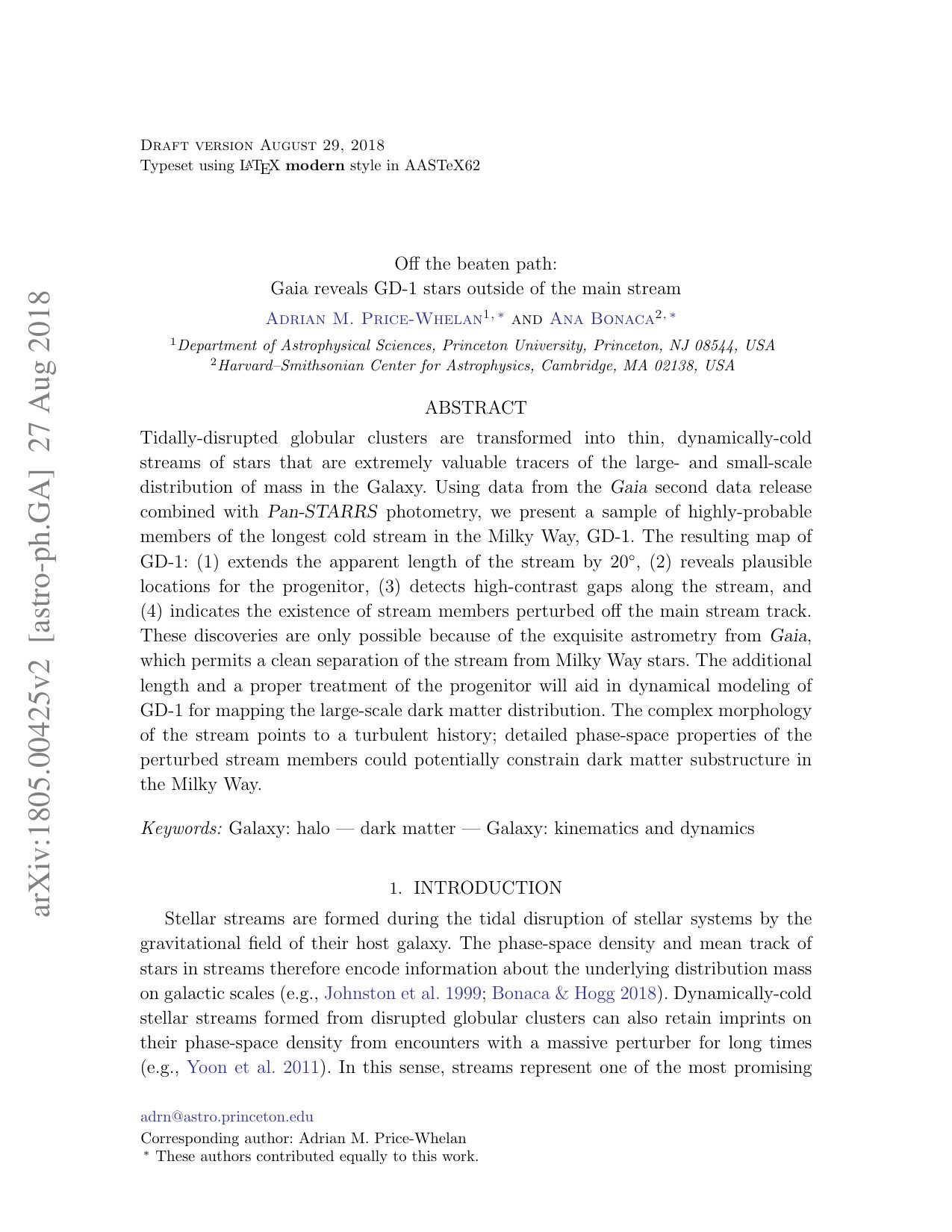
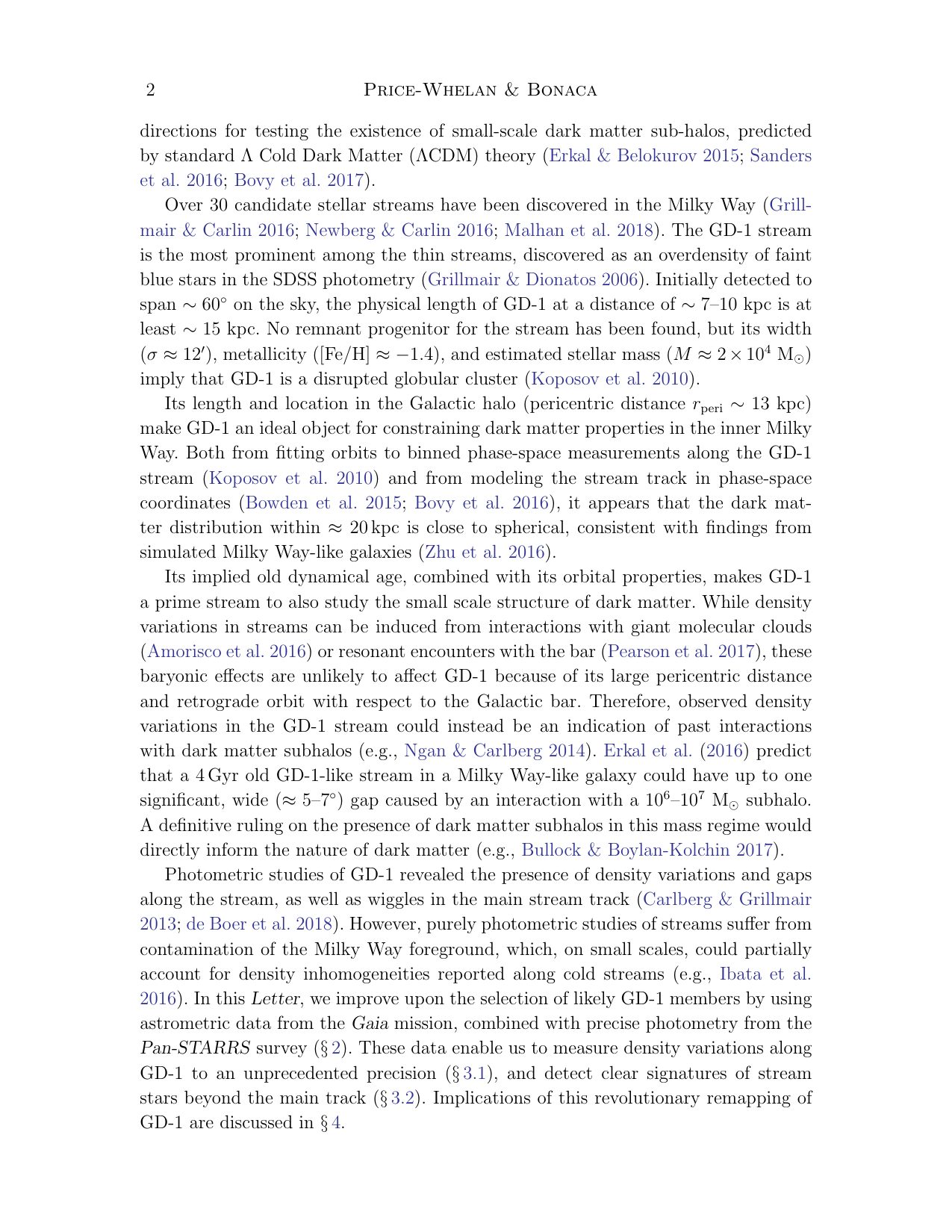
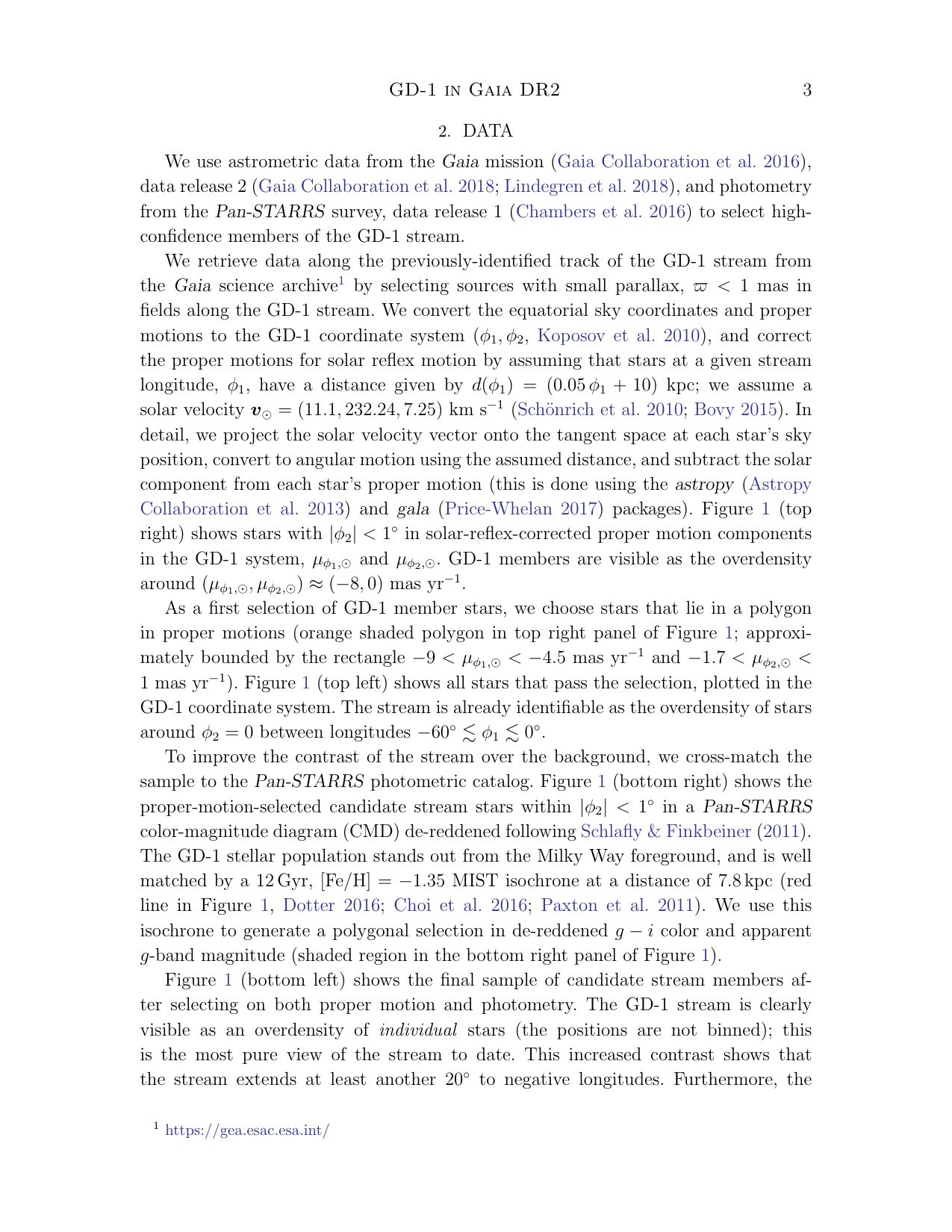
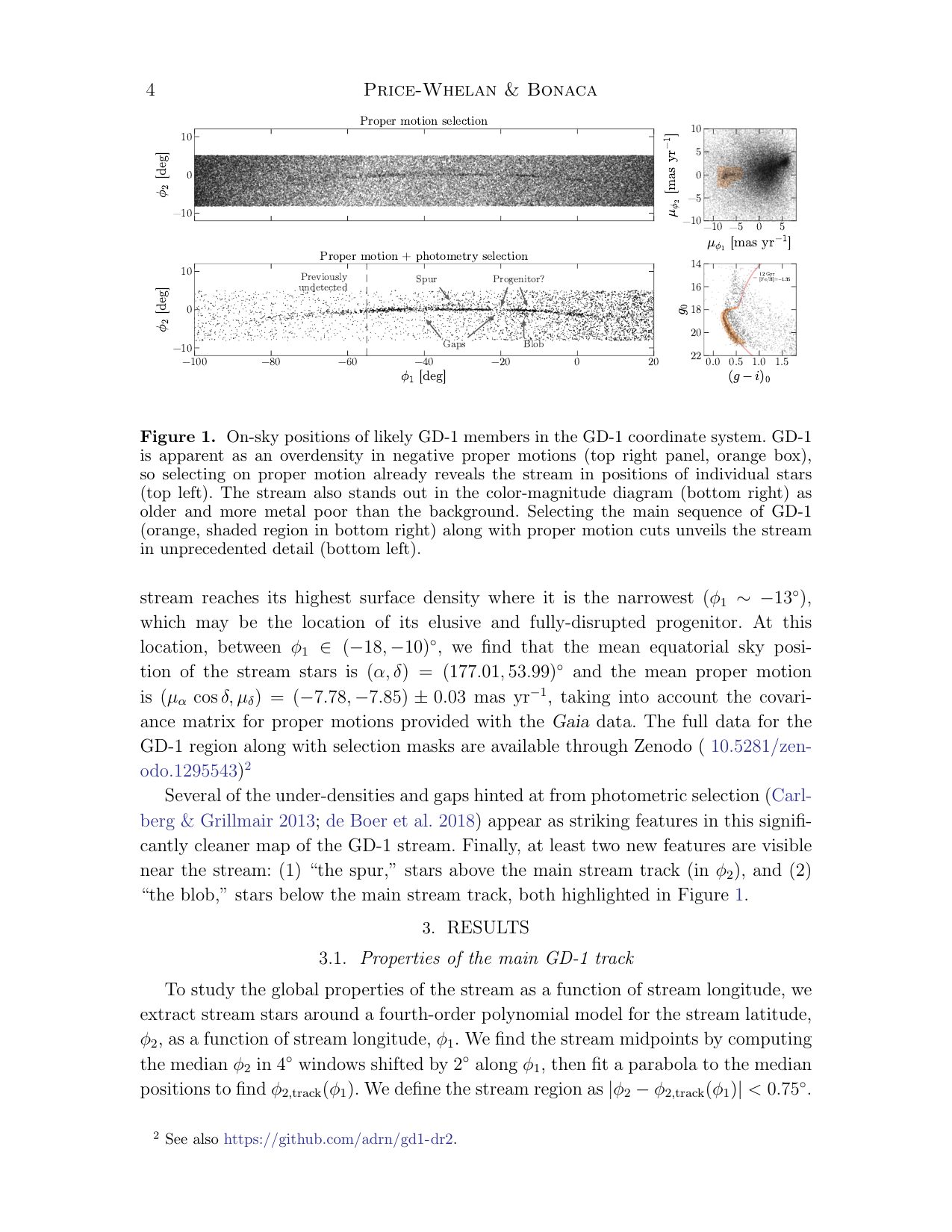
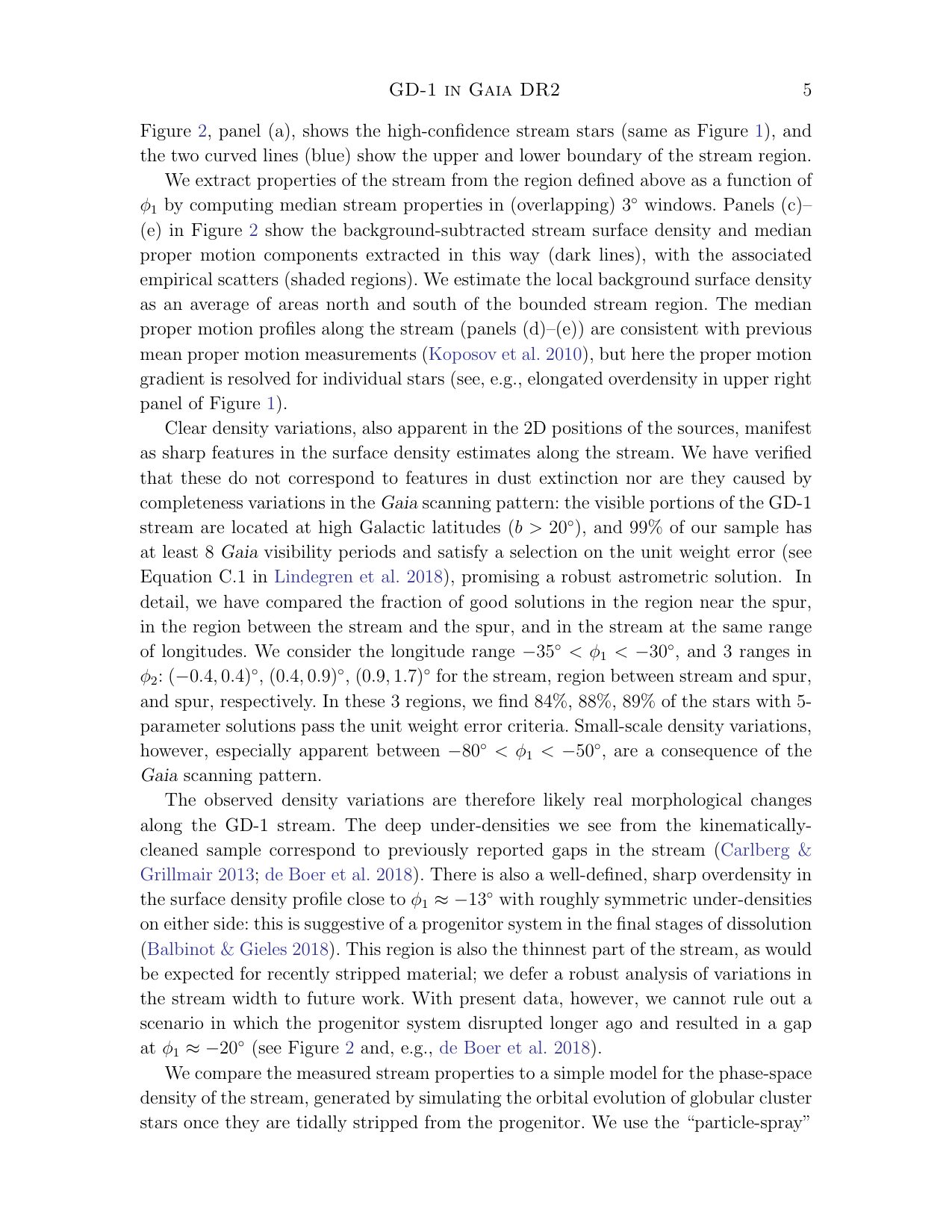
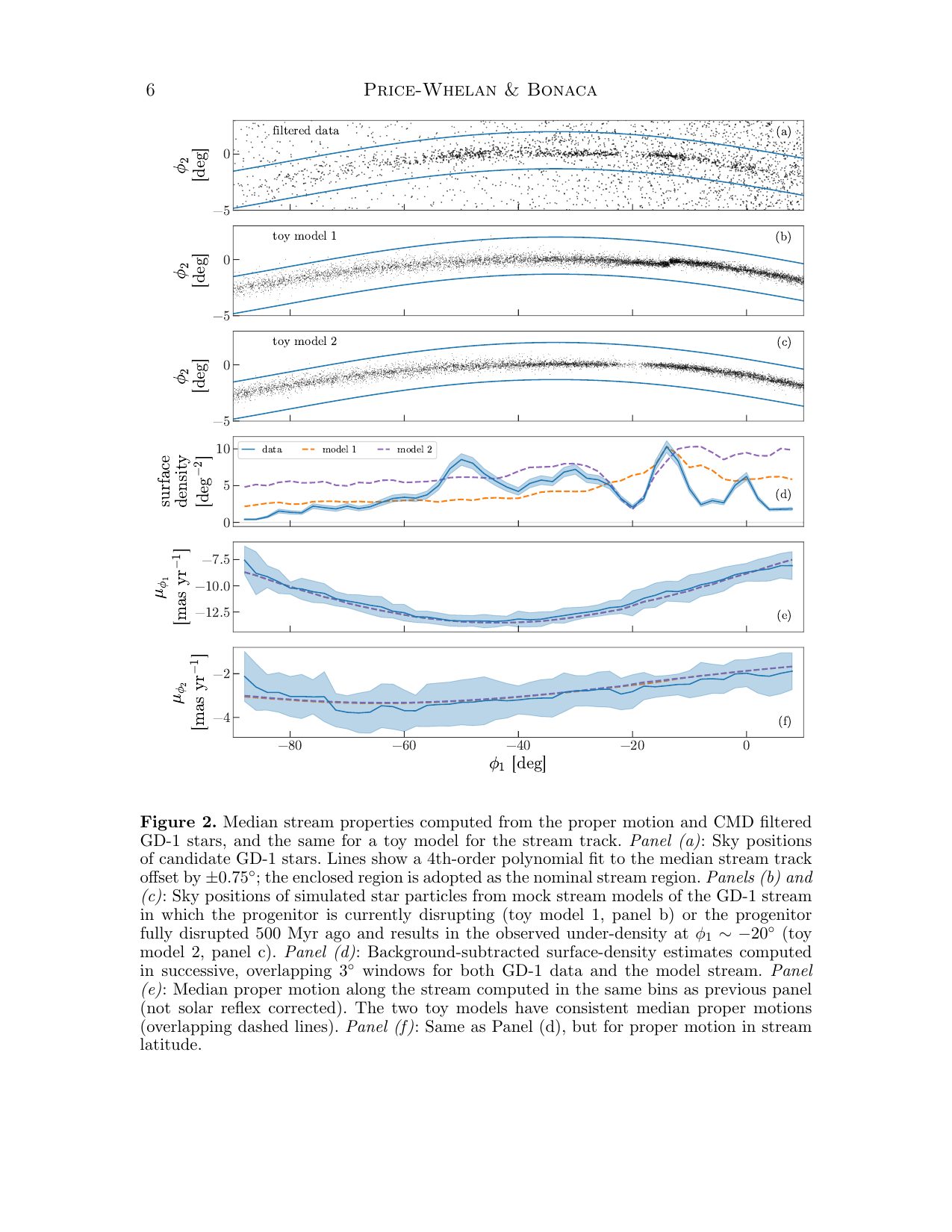
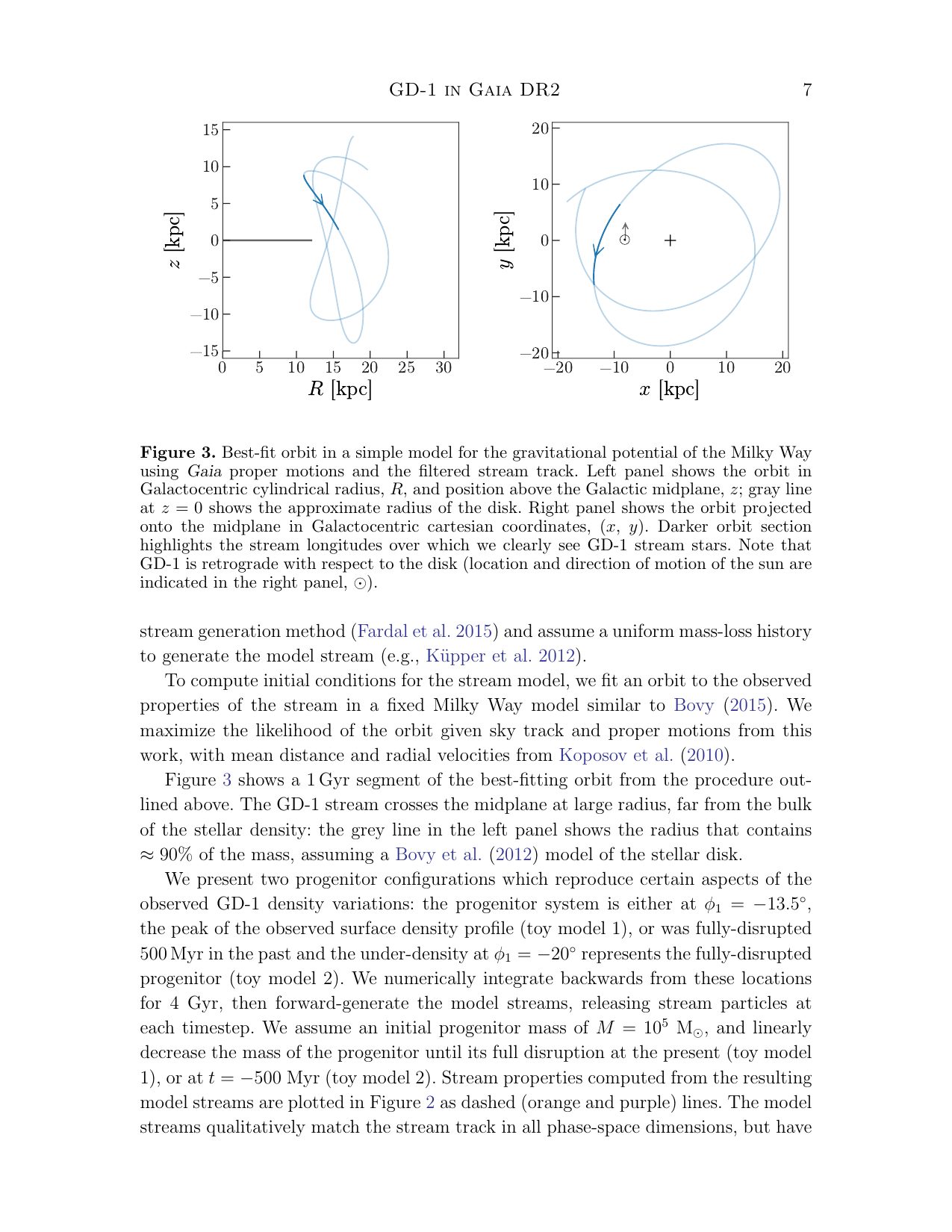
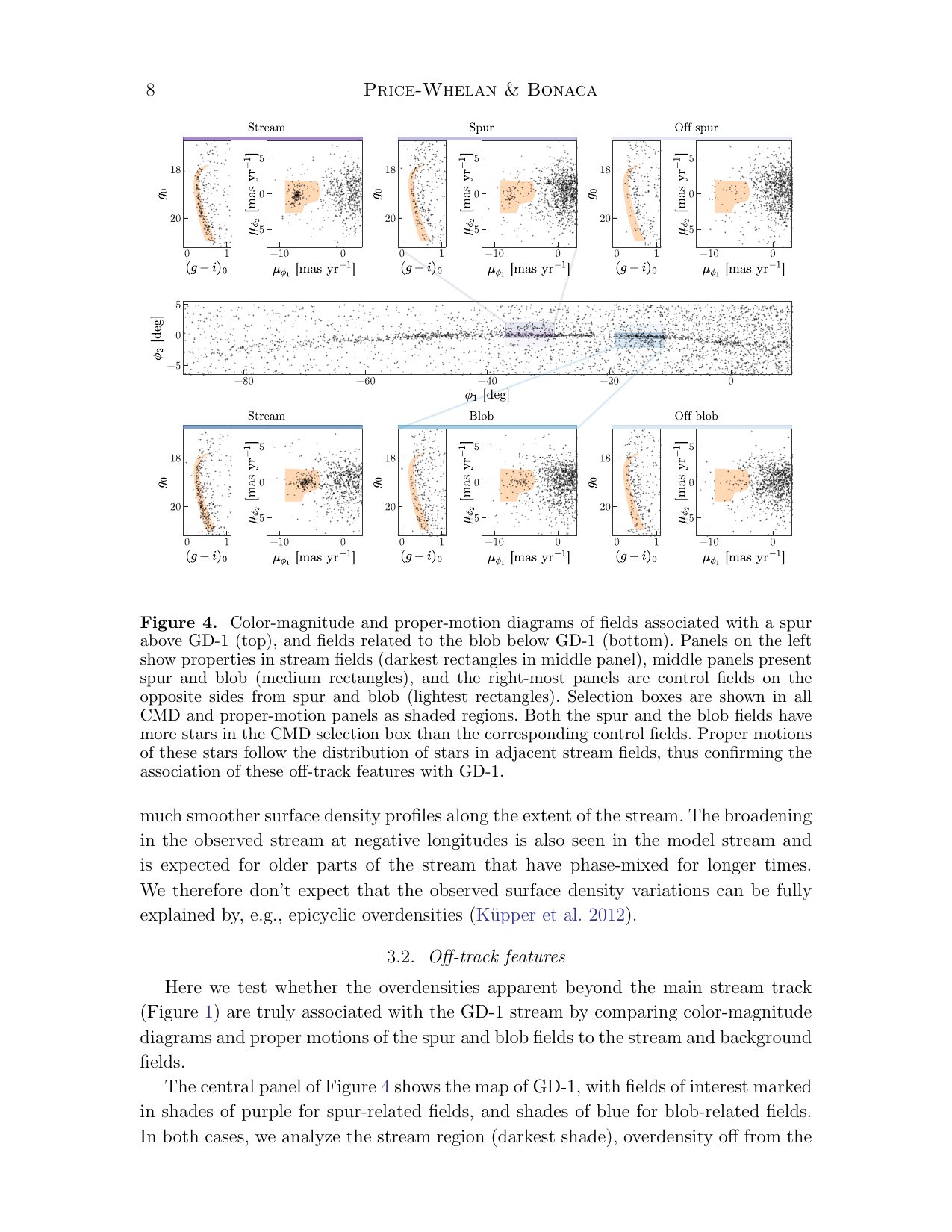
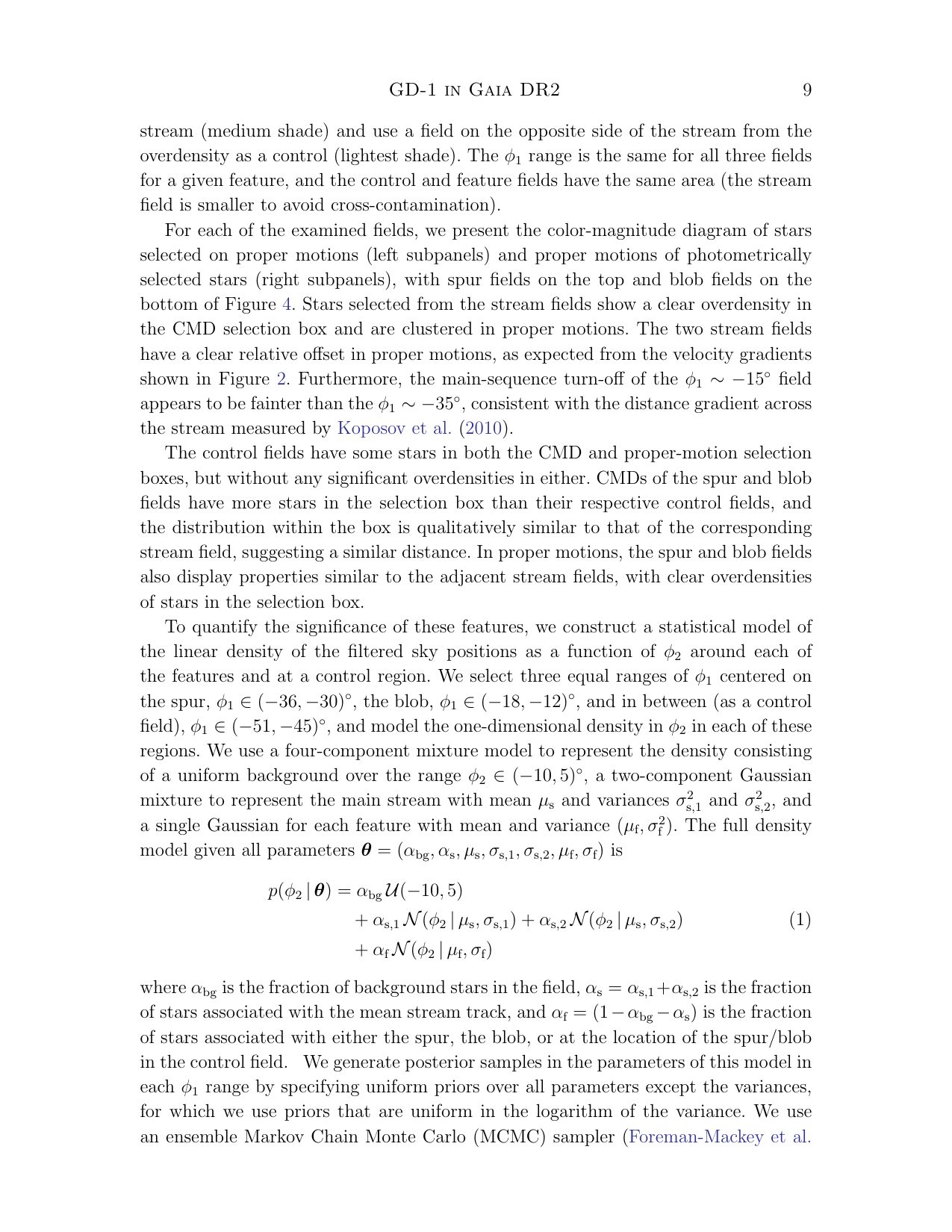
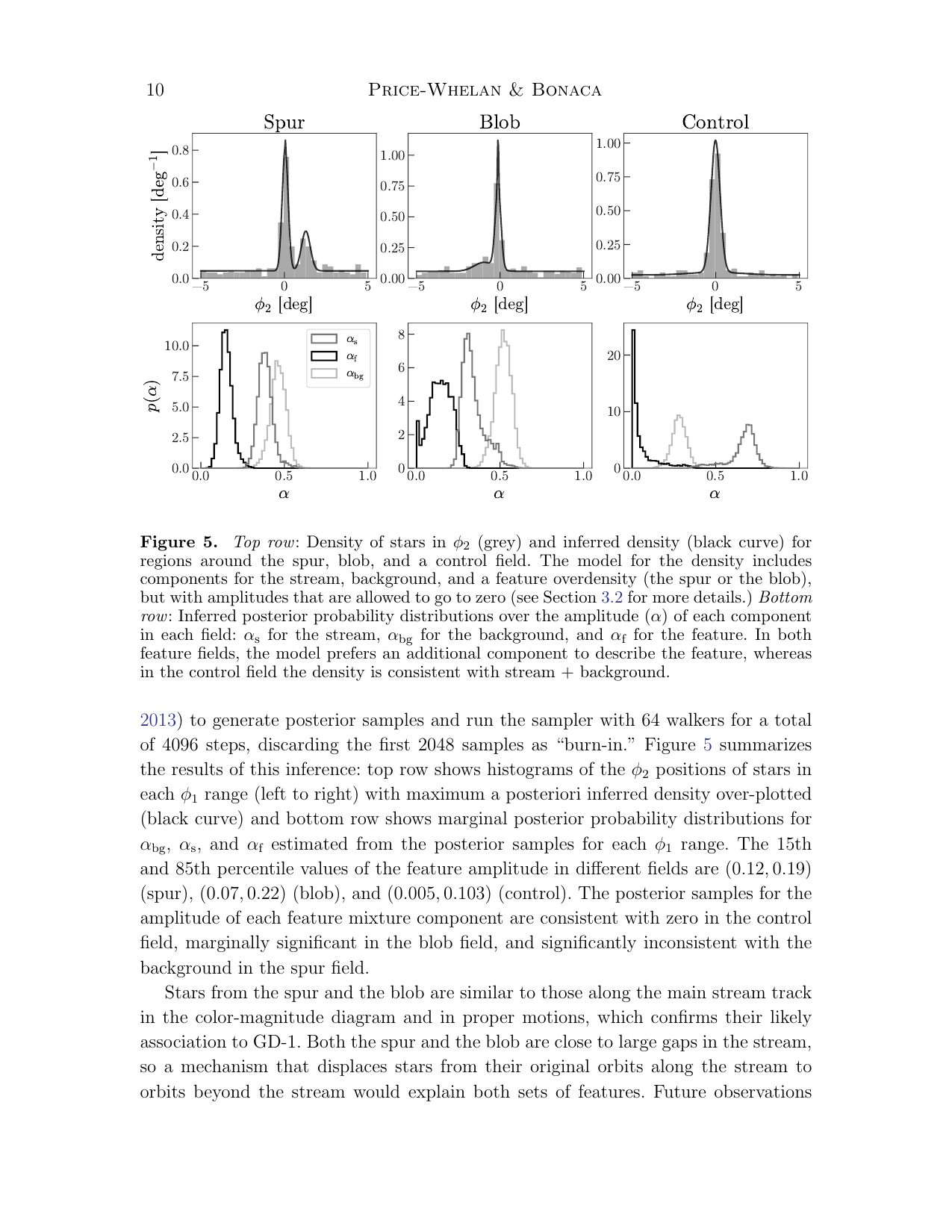
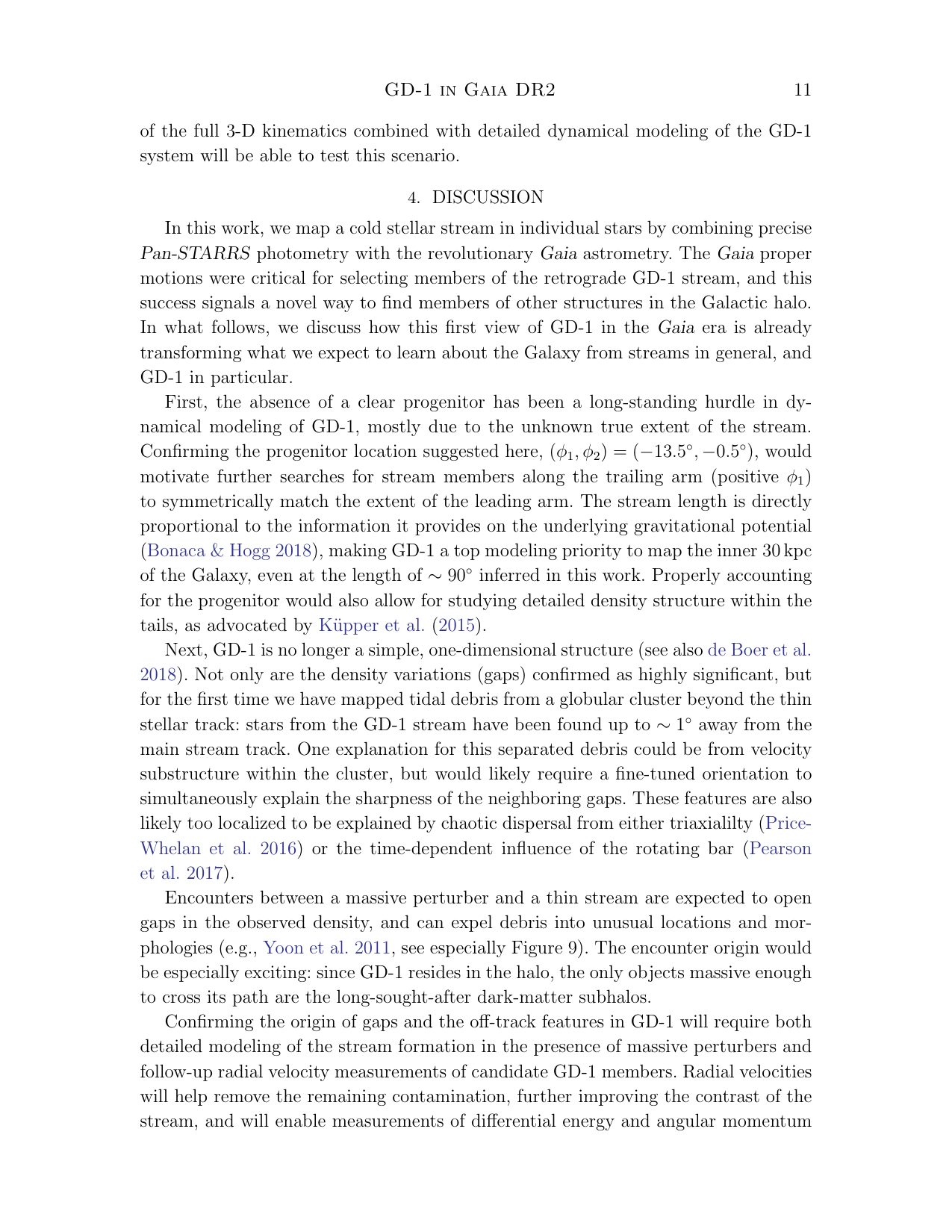
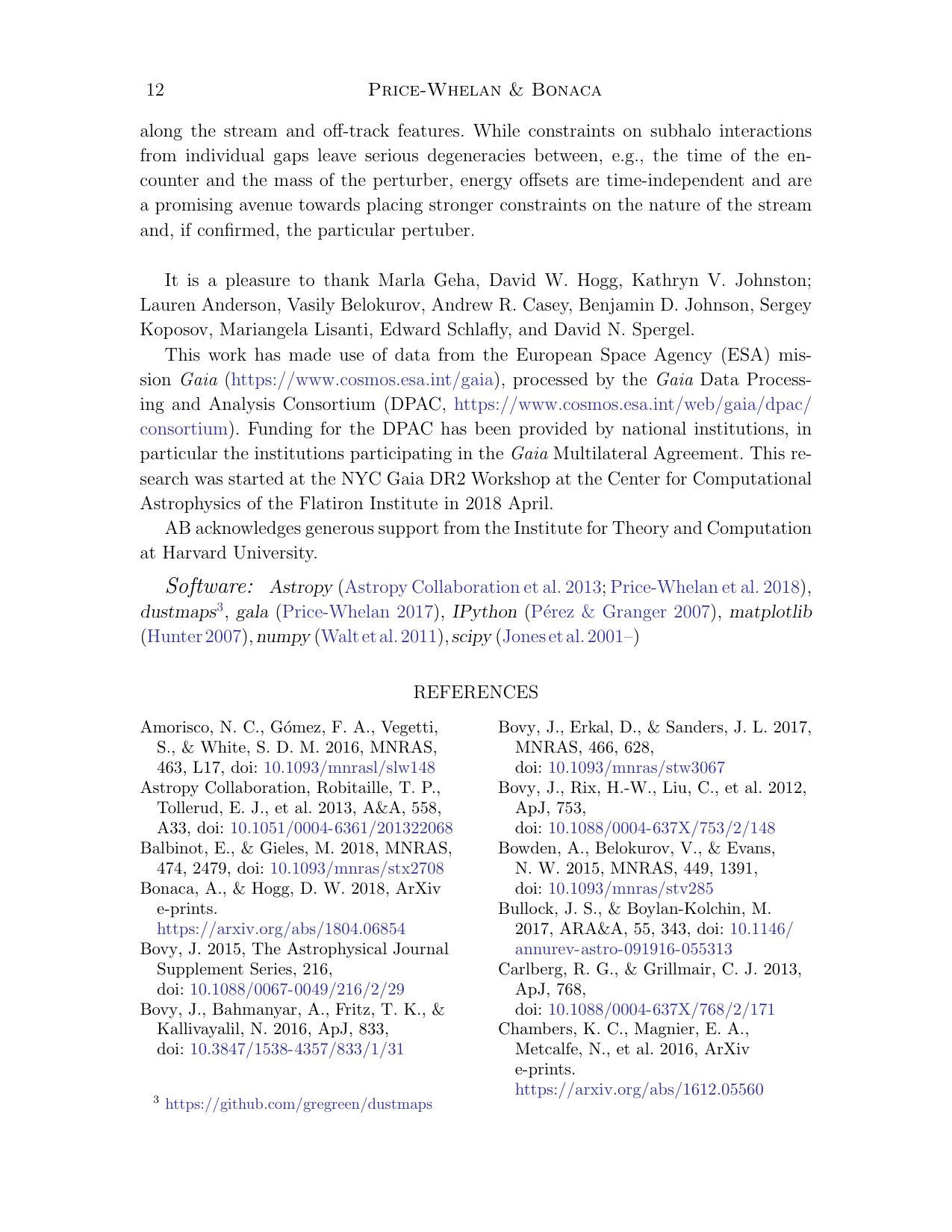
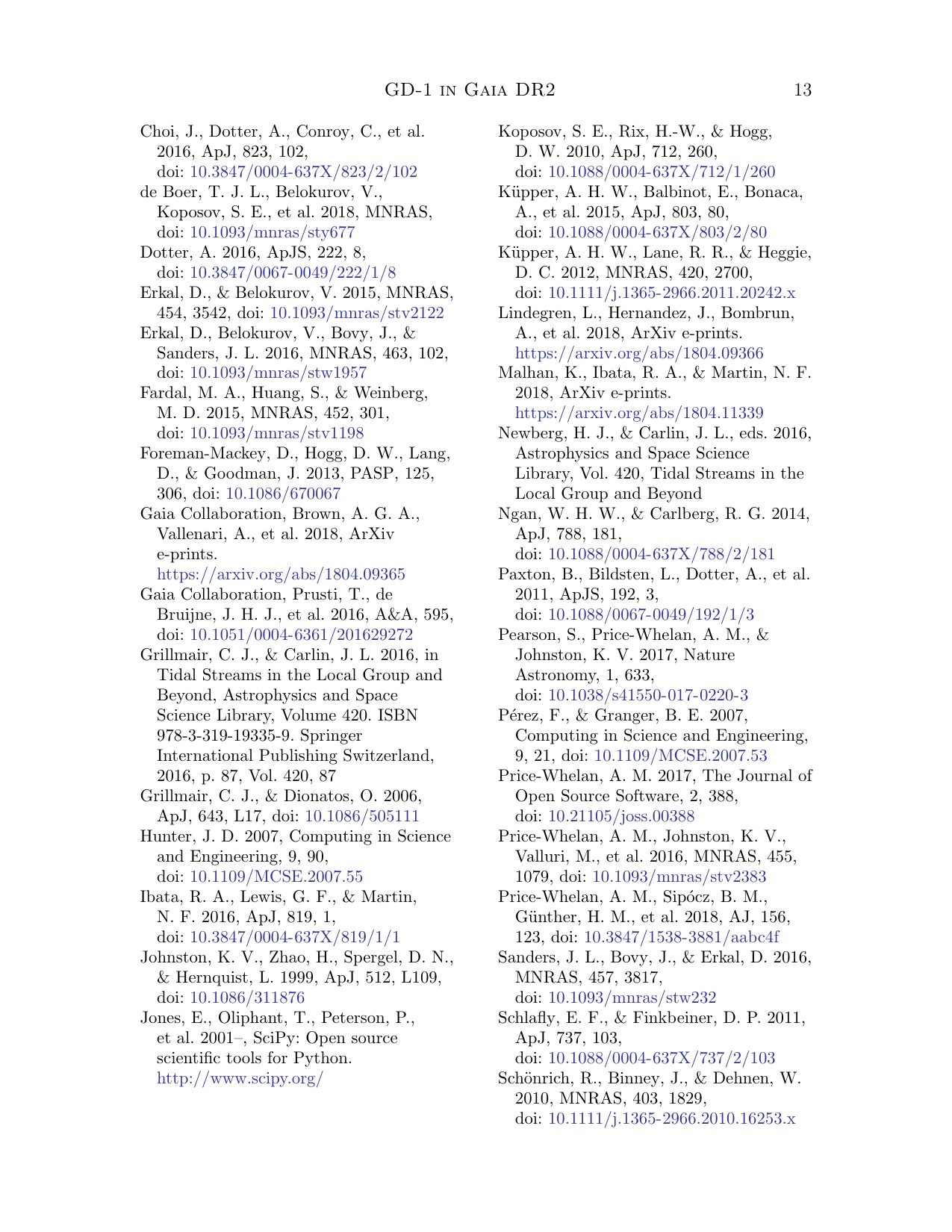
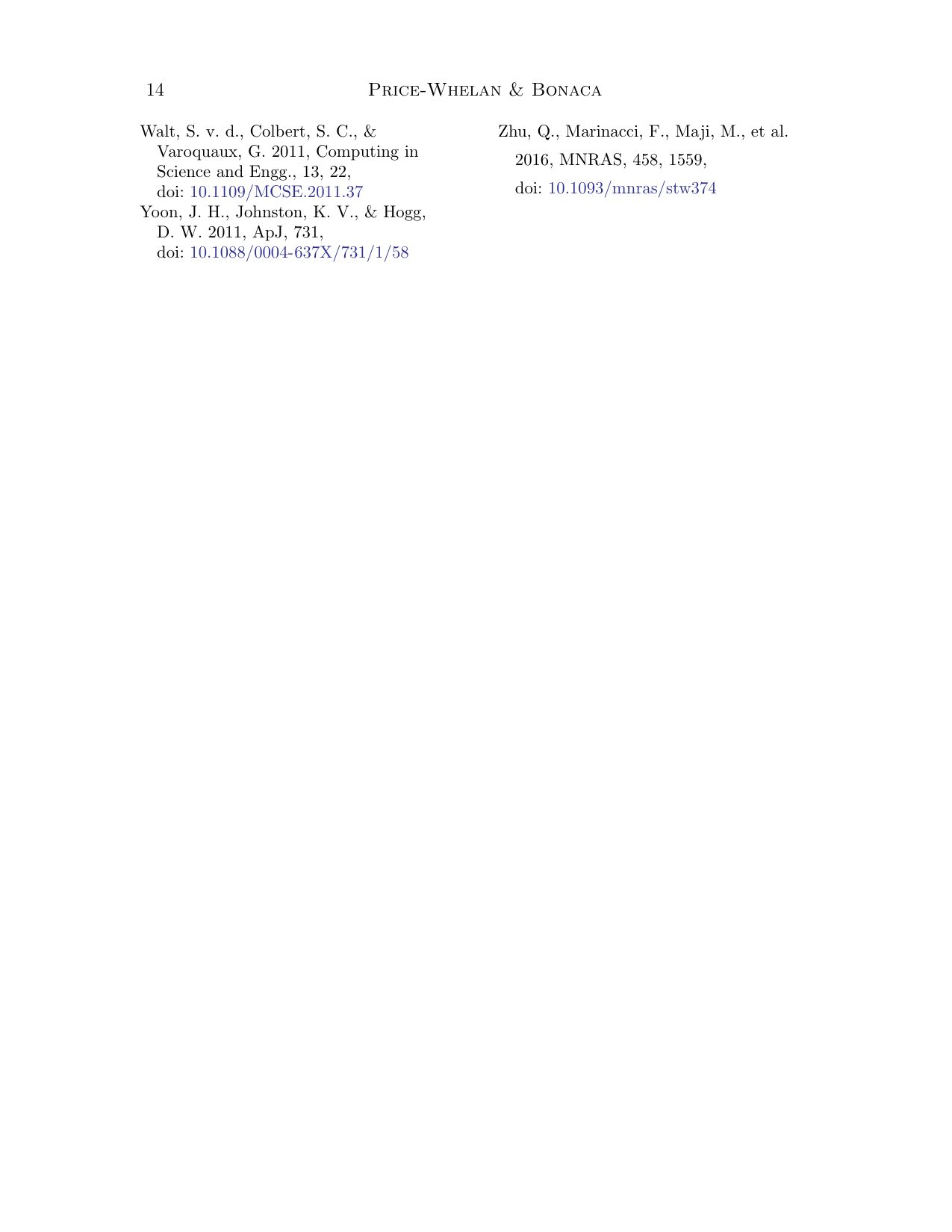
An executable edition of Price-Whelan & Bonaca (2018), Off the beaten path: Gaia reveals GD-1 stars outside of the main stream, rebuilt as a Lightcone project and written with MySTRA
arXiv1805.00425 Price-Whelan & Bonaca (2018), ApJL 863, L20 hover: lineage, record, plot, execution · click: pin
The paper becomes a window into the work.
A human-authored argument beside a navigable ASTRA research record.
Technical deep dive
The execution layer for ASTRA.
lc init · lc materialize · lc status
Turns an astra.yaml into enforced, reproducible execution —
making it mechanically impossible for an agent to produce a result that isn’t traced.
From a conversation to a recorded result
Claude Code plans a supernova analysis with the user, records the plan in ASTRA, then runs it and reports the result.
The agent cannot fabricate a result
The agent describes the analysis and drives the CLI — but it never writes a result itself. Every artifact is made by the engine, under a sandbox, and committed with the record of how it was made.
# The daily loop

$ lc init my-analysis           # idempotent: converges a project
  ✓ astra.yaml · pyproject.toml · uv.lock · .venv
  ✓ git + git-annex, so results travel with the repo

$ lc materialize                 # every output, every universe
$ lc materialize robust/fit      # one universe’s output
  → validate + resolve · Dask graph · sandboxed recipes
  → each result committed with its manifest + run record

$ lc status                      # reads only; always exits 0
  sandbox: landlock (fs: declared, network: allowed)
  · current  baseline/fit      a3f1f11
  · behind   robust/fit        00cc14e  earlier environment
  ! stale    baseline/fit_plot 9f2ab04  edited by hand
A tracked, reproducible environment
lc init converges the project on uv: the agent adds dependencies with ordinary uv add, and the resulting uv.lock is committed beside the spec. The environment an analysis ran in is part of the record.
Recipes run sealed in
lc materialize executes every recipe under a sandbox — Landlock on Linux, Seatbelt on macOS. A recipe cannot read a file that isn’t a declared input, and cannot reach a dependency outside the locked environment. Undeclared reads fail loudly instead of passing silently.
A hand-edited result gives itself away
Each output is committed with a content-addressed manifest and a replayable run record. Touch one outside its own run and it is a foreign write: the next lc status calls it stale and names the offending commit. The agent cannot write a number into a figure the engine didn’t produce.
The same project runs anywhere
An analysis is only reproducible if it stays executable — on the machine it was written on, and on whatever the next person has.

Laptop & workstation
LocalCluster
Write and iterate on the machine in front of you, using every core it has.
HPC — SLURM
pilot jobs
The very same lc materialize, with one Dask scheduler running inside the allocation. Nobody writes a batch script — least of all the agent.
Kubernetes & cloud
dask‑kubernetes · JupyterHub
New backends attach behind the same interface — a Kubernetes cluster, a JupyterHub deployment — and the analysis itself never changes.
Teaching any coding agent the stack
One plugin — lightcone — carries everything an agent needs to work on a project:
how to scope it, how to record it, and how to run it.
# one-time: register the marketplace
$ claude plugin marketplace add LightconeResearch/agent-skills

# install the plugin — it bundles everything
$ claude plugin install lightcone@lightcone-research

# then just ask
  /lightcone:lightcone   scope, run, debug, publish
  /lightcone:astra       the spec itself

Open Agent Skills standard — the same plugin in every harness.
github.com/LightconeResearch/agent‑skills
Scopes the project with you
It opens with an interview, not code: what the question actually is, which choices are genuinely open, and what the literature already settles — searched and quoted.
Documents every decision for you
Each methodological choice lands in astra.yaml as a decision — its options, its rationale, its evidence. The documentation you never sit down to write.
Drives the CLI to make the artifacts
It writes the recipes, calls lc materialize, reads the status back and diagnoses failures — so every output comes out of the engine, with its provenance, never out of the conversation.
Put to the test
in observational cosmology — on the DESI survey
Building these tools with scientists, on a real research project — to make sure they hold up against the complexity of the real thing.
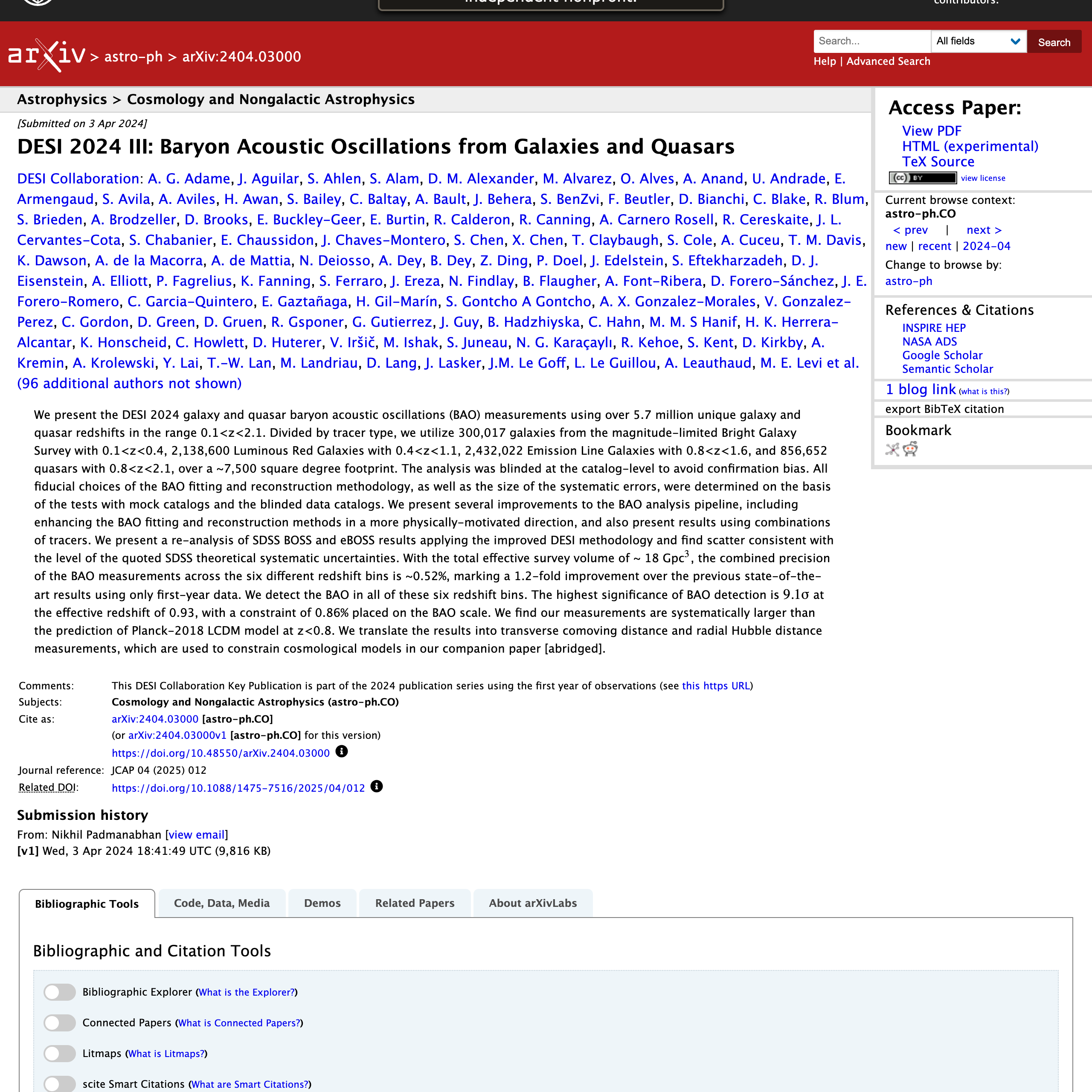
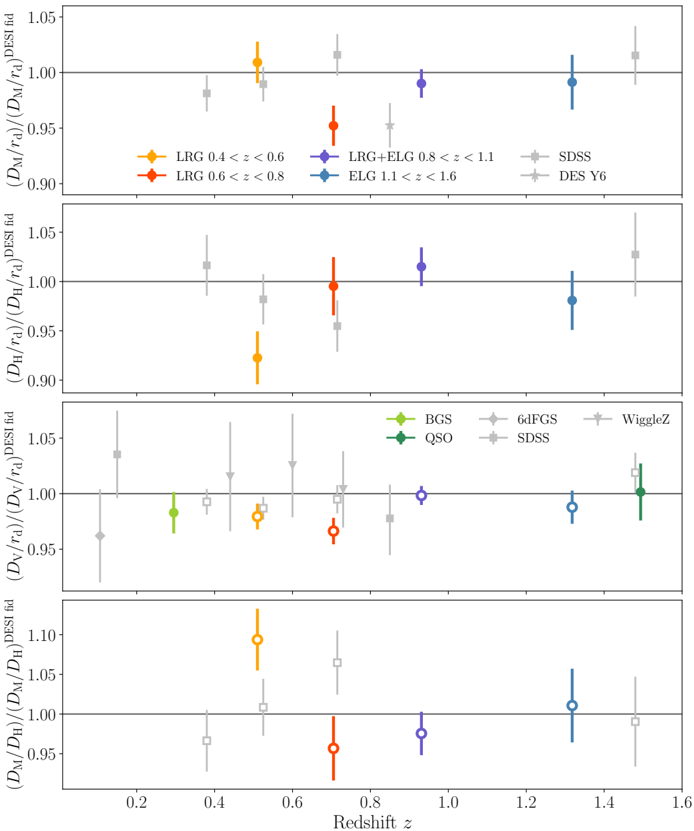
arXiv:2404.03000
DESI 2024 III: Baryon Acoustic Oscillations from Galaxies and Quasars.
Interactive render of the DESI survey — NOIRLab/DESI
Lightcone
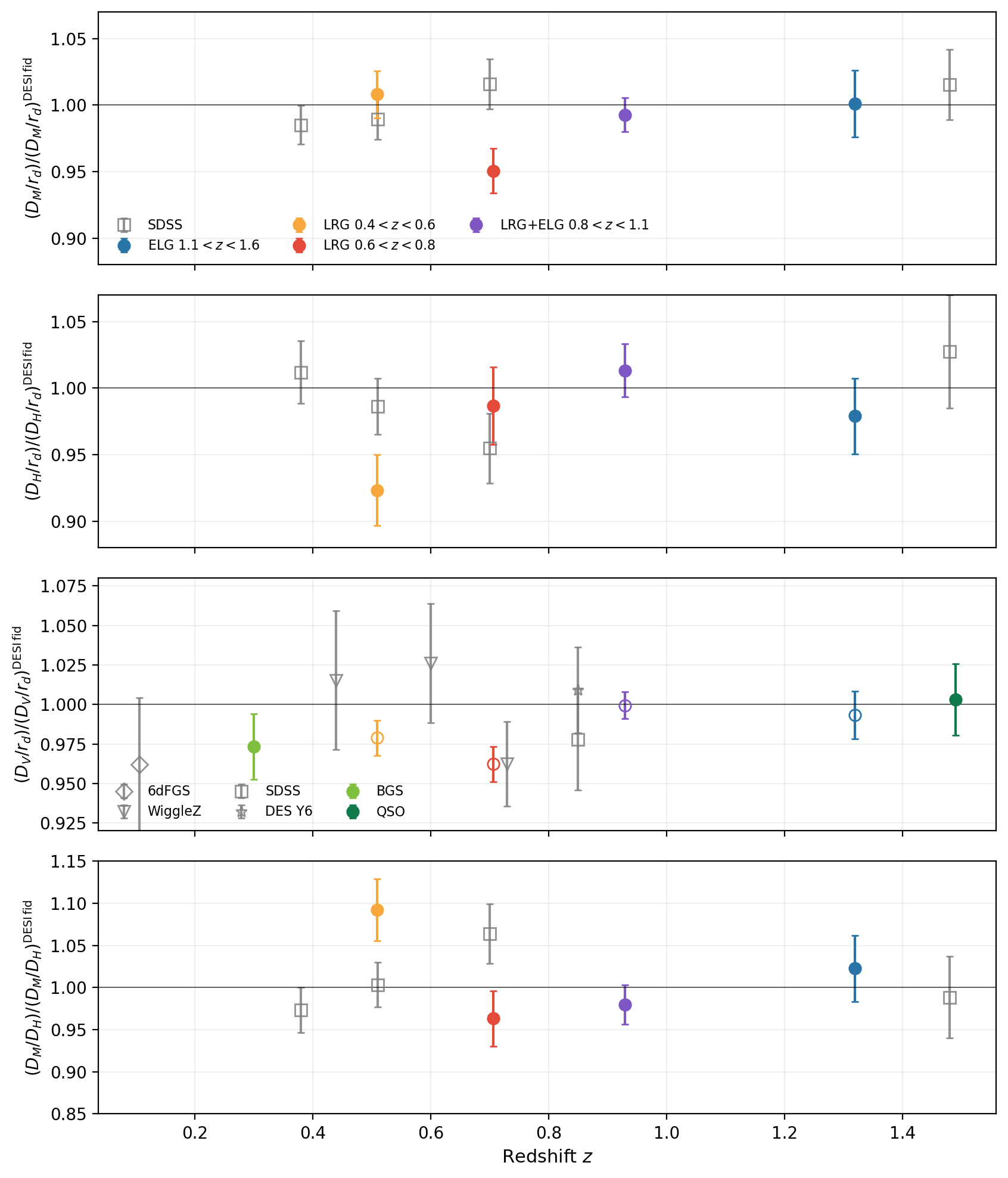
DESI 2024 III
From raw catalogs to the Hubble diagram.
damping_prior
gaussian
damping_prior_gaussian_fiducial
Tight Gaussian priors (width 1–2 h−1 Mpc) on the BAO damping parameters centred on theory values are recommended; fully fixing them risks biases and flat priors can also bias α and weaken constraints on noisy data.
damping_prior_width_justification
Biases of order 0.1% in αiso and 0.2% in αAP appear when the damping parameters are misspecified by more than ∼2 h−1 Mpc from their fiducial values — justifying Gaussian priors of width 1–2 h−1 Mpc.
sigma_perp_parallel_formula
Σ⊥ and Σ∥ follow Σ⊥ = Σ0·G, Σ∥ = Σ0·G·(1+f), with Σ0 = 12.4 h−1 Mpc for σ8 = 0.9 at z = 0 — the theoretical prediction that anchors the Gaussian prior centres.
flat
damping_prior_gaussian_fiducial
Flat priors can bias α and weaken constraints on noisy data; the same Chen+ 2024 analysis that motivates the Gaussian fiducial also rules flat priors out as the headline choice.
bias_weak_effect_on_sigma
Because Lagrangian displacements are dominated by bulk flows, galaxy bias has only a small effect on Σ⊥/Σ∥. With a flat prior the fit has no anchor against this near-degenerate direction.
Likelihoods and Systematic Errors for the DESI 2024 BAO Cosmological Analysis — Chen et al. 2024
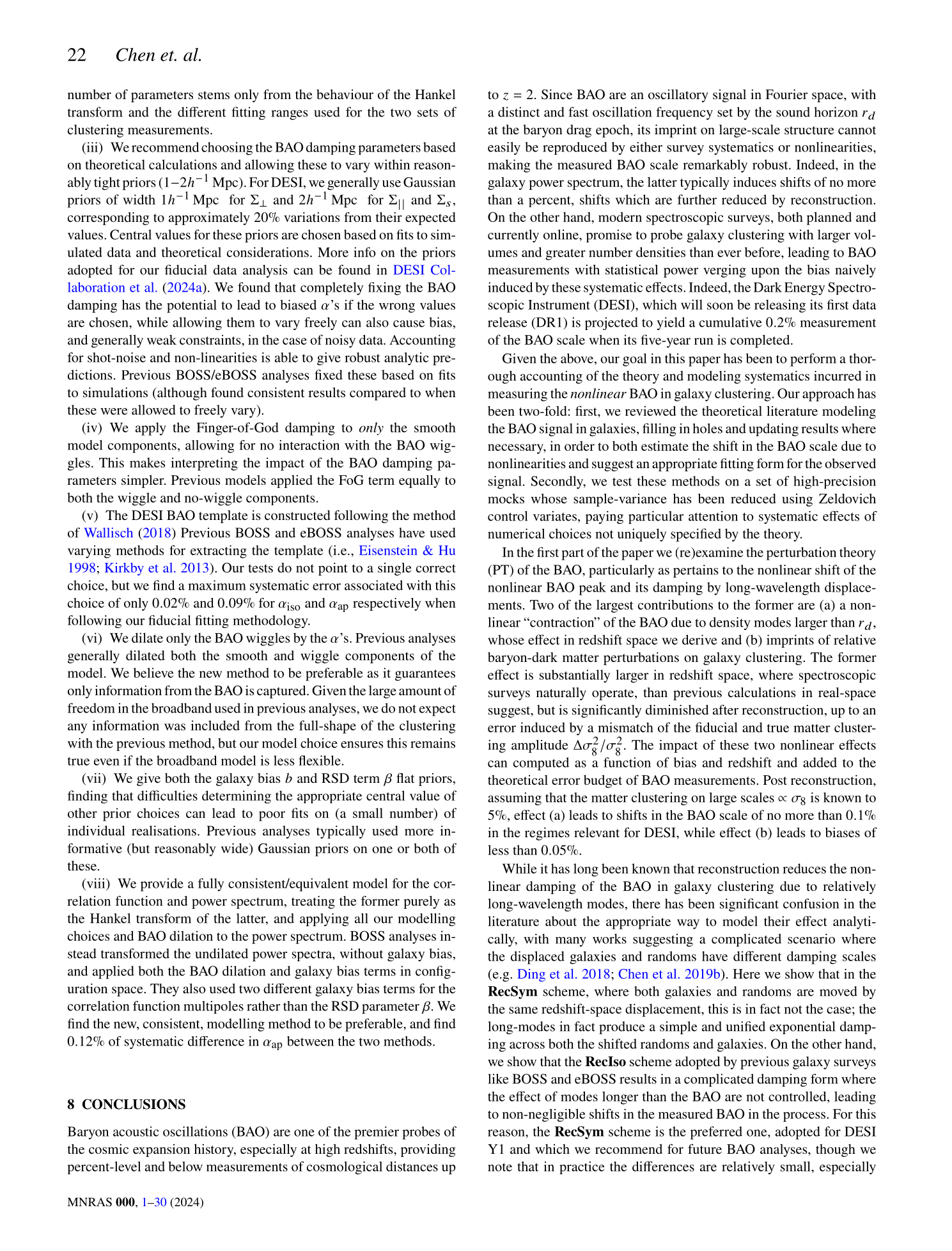
Insight
damping_prior_gaussian_fiducial
Tight Gaussian priors (width 1–2 h−1 Mpc) on the BAO damping parameters centred on theory values are recommended; fully fixing them risks biases and flat priors can also bias α and weaken constraints on noisy data.
● Evidence 1 · verbatim quote
We recommend choosing the BAO damping parameters based on theoretical calculations and allowing these to vary within reasonably tight priors (1−2 h−1 Mpc).
page 22 · right column · bullet (iii)
Reference
We are hiring our founding team
Three Members of Technical Staff — distinct roles, one team. Joining now means real ownership of the abstractions, tools, and norms that will define Lightcone Research.
Product Engineer
BerkeleyInvent how scientists actually work with research agents — scoping problems, steering long-running work, reading progress and uncertainty, and trusting what gets produced.
Research Software Engineer
BerkeleyBuild the infrastructure underneath it — open specifications, agentic tooling, evaluation systems, scientific workflows, HPC integration, provenance and reproducibility.
Research Engineer
ParisA broad, founding role spanning agentic systems, scientific infrastructure and the researcher experience — building the European side of Lightcone Research.
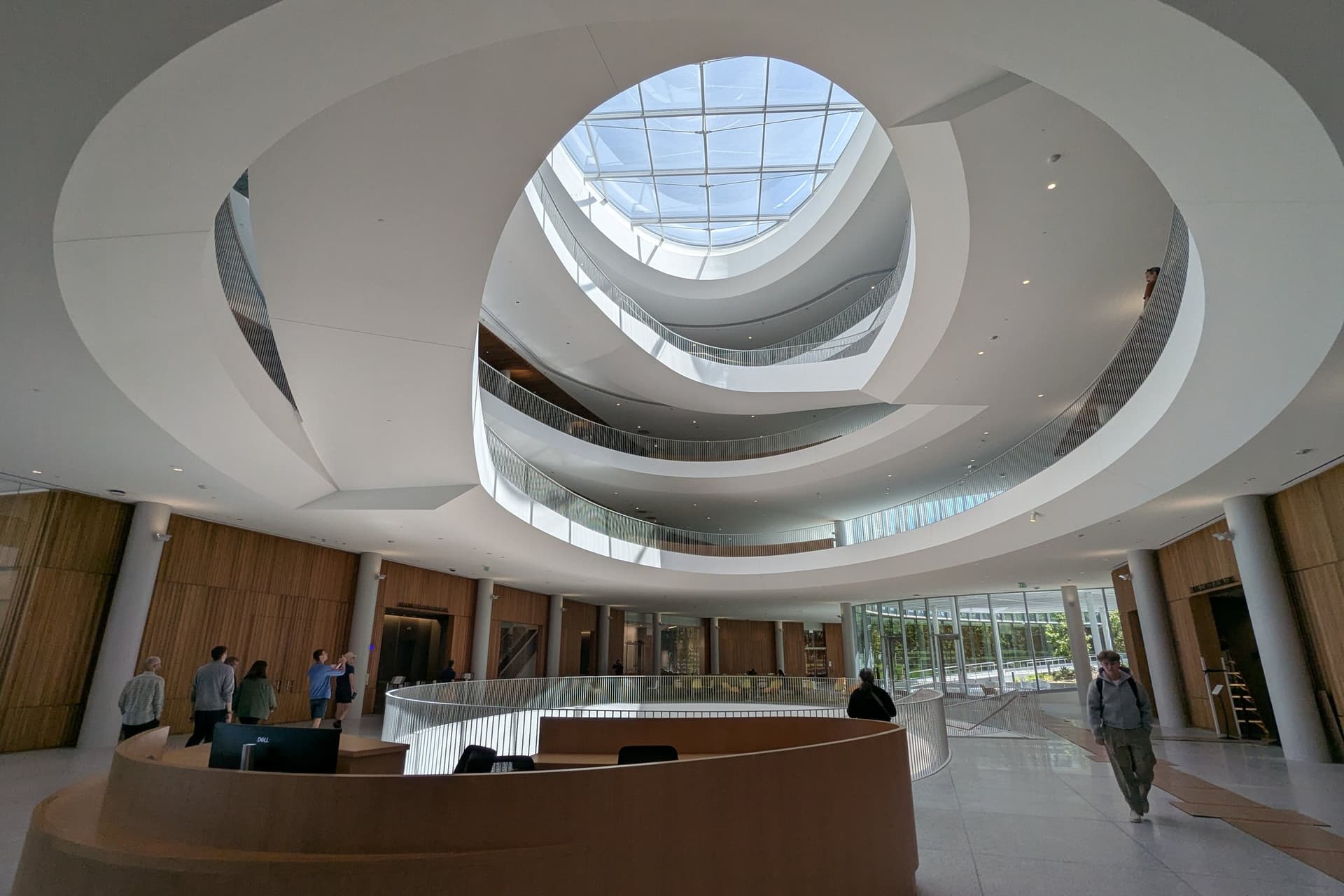
Berkeley at BIDS, in the new Bakar Gateway building — surrounded by the Scientific Python and Jupyter communities. Paris in the city, alongside our CNRS AISSAI colleagues.
lightconeresearch.org/careers or write to info@lightconeresearch.org
Work with us
Help us build the open substrate for scientific research
in the age of AI.
info@lightconeresearch.org · lightconeresearch.org · Discord