

Connecting humans to reproducible, composable
analyses in the age of AI agents

IN2P3/IRFU Machine Learning Workshop 2026 LPSC, Grenoble – Tuesday 17 November 2026

Alexandre

Alexandre Boucaud

CNRS – APC / IN2P3

AISSAI — CNRS Berkeley Institute for Data Science

Takeaways from early examples of machine-scale discovery

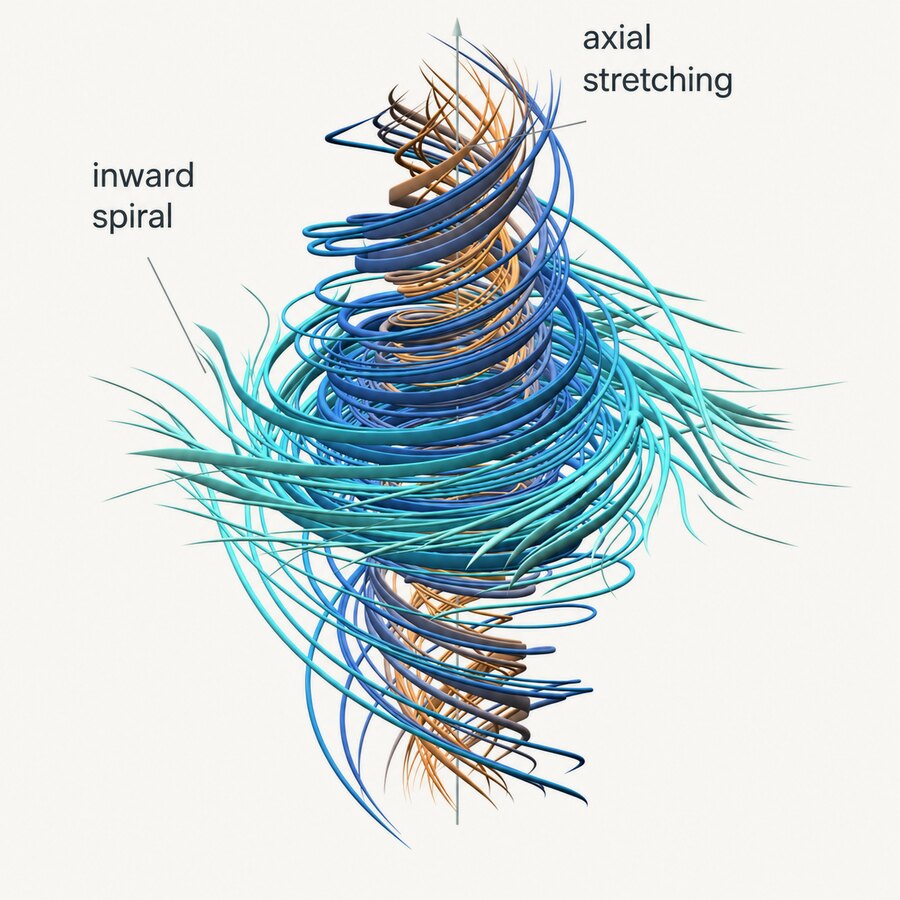
OpenAI's illustration of the blow-up mechanism: a swirling vortex with an inward spiral and axial stretching.

OpenAI · 8 Sept 2026

“An OpenAI model proposes a solution to the Navier–Stokes Millennium Prize Problem”

Image: OpenAI. Finite-time blow-up with forcing (Clay alternatives C & D).

1 · Substrate for machine research

~130B tokensfrom ~10,000 agents
Lean + Mathlibthe format to check and extend it

Machine-scale research requires a shared, verifiable, machine-native substrate

2 · Connection to human science

“Our ideas we disseminate in talks, private discussions and careful writeups, connecting them to the previous ideas of others. These processes invariably take time and are based on human interaction.” — A Severe Misalignment of AI in Mathematics, signed by 28 Fields Medallists, 11 Sept 2026

Staying connected to human scientific communities imposes fundamental boundary conditions

Machine-scale research that preserves human understanding and agency

AI research system

Machine-scale

The record must be

  • Standardizeda common format that makes the work shareable with any person or agent
  • Verifiableevery result can be checked and traced to how it was made
  • Compoundingnew work builds directly on prior results

Capture research at machine scale, without requiring human review of every intermediate step

Distillation Impulse

Research community

Human-scale

The record must support

  • Human understandingpeople need to understand enough to assess, use, and redirect the work
  • Human communicationinsights travel through talks, discussions and careful writeups
  • Human agencypeople own the questions, out of curiosity or for social good

Its record is bounded by human scale, and may not look so different from today’s papers

One record, legible by agents and researchers

ASTRA

ASTRA

the structured record that compounds

A declarative spec of an analysis: inputs, decisions, outputs, prior insights and findings, each tied to its evidence. Agents write it; anyone can re-run, check and extend it.

astra‑spec.org

MyST

Mystra

the bridge to the human story

MyST for ASTRA: the paper’s prose references the analysis instead of restating it. Every number in the text resolves to the record behind it.

MyST · Jupyter Book 2

Jupyter

Lightcone Lab & UIs

human understanding and control

A JupyterLab extension to navigate, inspect and steer the record — it runs wherever JupyterLab and JupyterHub already do.

pip install jupyterlab-lightcone

ASTRA v0.1 is in beta — try it and tell us what breaks; it is not production-ready yet.

Team

An international, open-source initiative — with scientists, for scientists — based at UC Berkeley (BIDS) and the CNRS (AISSAI).

Team

François Lanusse

François
Lanusse

CNRS

Liam Parker

Liam
Parker

UC Berkeley

Alexandre Boucaud

Alexandre
Boucaud

CNRS

Cail Daley

Cail
Daley

CEA

Kangning Diao

Kangning
Diao

UC Berkeley

Nolan Koblischke

Nolan
Koblischke

U. Toronto

Kirstie Whitaker

Kirstie
Whitaker

UC Berkeley

Tom Charnock

Tom
Charnock

Member of Technical Staff

Advisors

Debbie Bard

Debbie Bard

Science Engagement &
Workflows Dept. Head

NERSC

Kyle Cranmer

Kyle Cranmer

Director,
Data Science Institute

UW–Madison

Fernando Pérez

Fernando Pérez

Faculty Director,
Berkeley Inst. for Data Science

UC Berkeley

Uroš Seljak

Uroš Seljak

Co‑Director, Berkeley Center
for Cosmological Physics

UC Berkeley

Associated centers

Berkeley Institute for Data Science AISSAI

Philanthropic support

Eric & Wendy Schmidt

Eric & Wendy Schmidt

The shape of a shareable machine record

The UC Berkeley Campanile above the San Francisco Bay
First AAI4Science Developer Summit
AI Futures Lab, Berkeley · July 28–31, 2026
QR code to the summit write-up Read the summit write-uplightconeresearch.org/blog
Deep verification

Re-run the analysis with alternative choices to test its results and conclusions, not just repeat it.

Human credit

People’s contributions stay visible and citable, so the work they put in is recognised.

  • Captures the scientific context

    The question, assumptions and methodological choices, and the reasons for them: a reader must see why the analysis was done and where judgment entered it.

    Deep verification
  • End-to-end provenance and extensibility

    Each figure, measurement and claim links to its decisions, code, inputs and execution context, with no unrecorded gaps in between, so others can rerun and extend it.

    Deep verification
  • Addressable and citable at every level

    Each result, decision and dataset has a stable identity, so it can be cited, reused and referenced from other analyses across the corpus.

    Human credit
  • Verification record

    Checks, outcomes, reviewer identity and open concerns, attached to what they verify, keeping “it runs” apart from “it is right”.

    Deep verificationHuman credit
  • Preserving failed attempts and negative results

    Failed runs, discarded hypotheses and changes of direction become reusable knowledge, and show which choices came before or after seeing the data.

  • Attribution and credit

    Who proposed, implemented, accepted and verified each step, human or agent, keeping both credit and responsibility visible.

    Human credit

ASTRA: Agentic Schema for Transparent Research Analysis

informs parameterizes parameterizes feeds evidences

◈Prior insight

MWPotential2014: bulge, disk and NFW halo, 220 km/s at the Sun

Bovy 2015 · DOI + verbatim quote

▤Input

Koposov et al. distances

▤Input

Koposov et al. radial velocities

◇Decision

Milky Way potential

  • Paper 2018 potential
  • Gala Milky Way v1
  • Gala Milky Way v2 ◈

◇Decision

Progenitor mass

  • 10⁵ M☉, losing mass
  • 6 × 10⁴ M☉

◆Output · data

Orbit fit

python fit_orbit.py--potential {decisions.potential}

◆Output · data

Particle-spray toy streams

python spray_stream.py--mass {decisions.progenitor_mass}

◆Output · figure

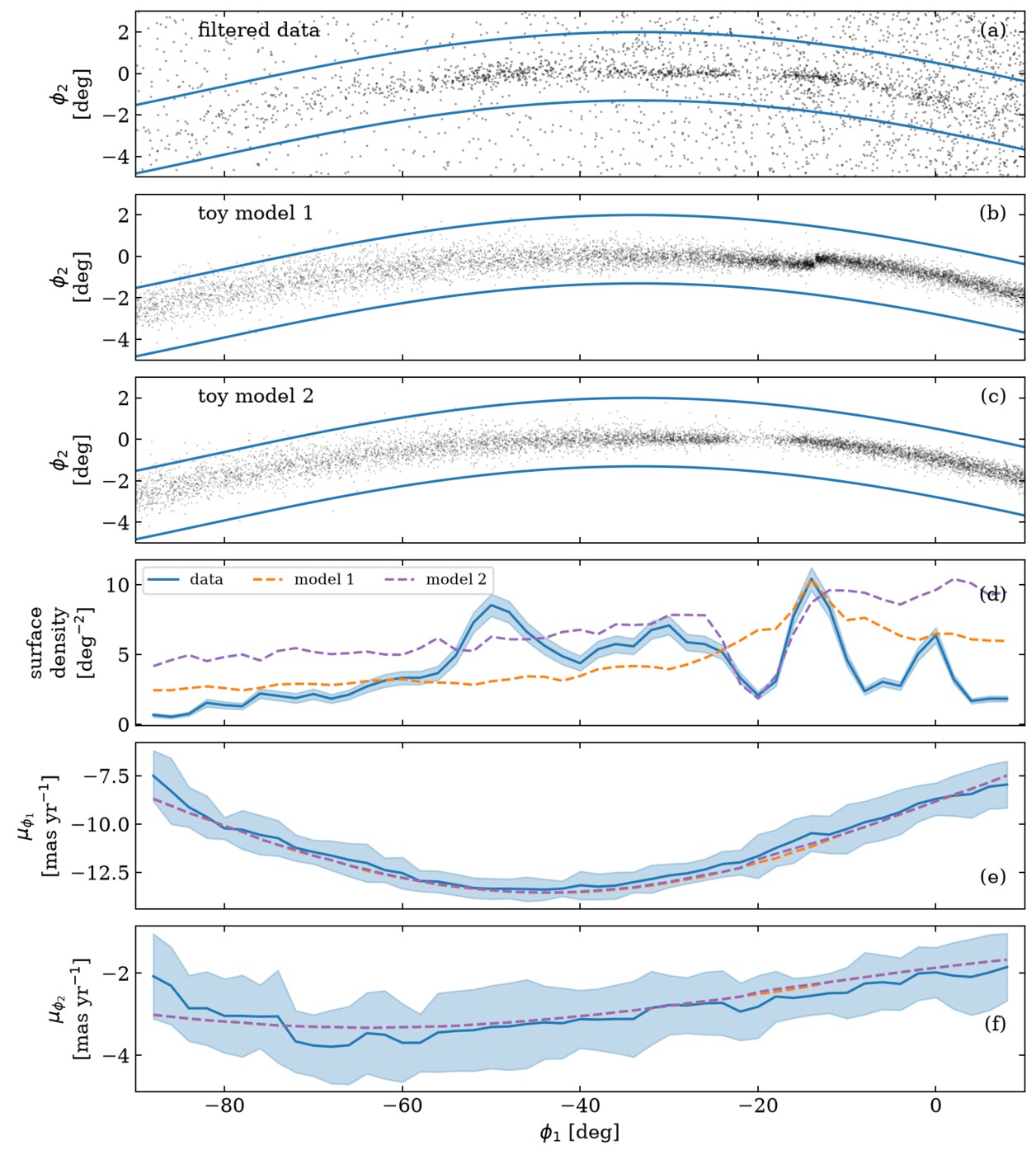
Figure 2: data vs toy streams

python plot_density.py--models {outputs.toy_streams}

●Finding

GD-1 is clumpier than smooth-potential models predict

density scatter 0.58, vs 0.31–0.44

Provenance‑certifiedEvery plot, number and claim ties back to the data, code and decisions that produced it.

Fully observableCode and artifacts, but also every consequential decision and the reasoning behind it, are inspectable.

Scientifically legibleOrganized around the claims, decisions and insights that matter, with direct paths down into the evidence.

A paper is no longer a single file.

It is a bounded contribution inside a research graph that keeps going.

paper_final_v7.pdf

Measuring the BAO distance scale

A. Researcher, B. Scientist, et al.
Methods
Results
the trail stops here
future paper · conceptual publication boundary
ASTRA · structured research record
◐sub-analysis
Catalog preparation
◐sub-analysis
BAO fitting
◐sub-analysis
Distance synthesis
◇assumption · decision
damping_prior baseline → gaussian
◆output
distance table CSV · materialized
●finding
null tests stable artifact-backed
MyST · authored narrative
Measuring the BAO distance scale

We adopt a ◇ Gaussian damping prior, supported by prior work.

The combined tracer gives 19.88 ± 0.17, resolved from the active output at build time.

Every reference opens the record behind the statement.

◈literature
Chen et al. 2024 DOI · p. 22
◐prior work
Covariance validation ASTRA v1.2
◐next work
Cosmology inference consumes output
Today, the scientific record is flattened into one frozen projection.

The paper references the analysis

MyST

MyST is Jupyter’s open document engine for science — Markdown with equations, citations, cross-references and executable content, built into websites, PDFs, or the JATS XML journals actually ingest.

It is the engine behind Jupyter Book 2, and behind AGU’s Notebooks Now! — publishing computational notebooks as first-class elements of the scientific record.

MySTRA, our MyST plugin, lets the prose reference the analysis instead of restating it:

Under the {astra}`decisions.bao_fit_method`
we measure α = {astra:value}`outputs.alpha_iso`.

:::{astra} outputs.bao_fit_plot
:::

The decision links to its full record, the number is read live from the result table, and the figure is the materialized artifact. One source of truth — re-run the analysis and the paper updates itself.

mystmd.org

mystviewer.org/eiffl/myst_proto — DESI DR1 BAO measurement reproduction

Teaching any coding agent the stack

One plugin — lightcone — carries everything an agent needs to work on a project: how to scope it, how to record it, and how to run it.

# one-time: register the marketplace
$ claude plugin marketplace add LightconeResearch/agent-skills

# install the plugin — it bundles everything
$ claude plugin install lightcone@lightcone-research

# then just ask
  /lightcone:lightcone   scope, run, debug, publish
  /lightcone:astra       the spec itself
Claude Code Codex

Open Agent Skills standard — the same plugin in every harness.
github.com/LightconeResearch/agent‑skills

Scopes the project with you

It opens with an interview, not code: what the question actually is, which choices are genuinely open, and what the literature already settles — searched and quoted.

Documents every decision for you

Each methodological choice lands in astra.yaml as a decision — its options, its rationale, its evidence. The documentation you never sit down to write.

Drives the CLI to make the artifacts

It writes the recipes, calls lc materialize, reads the status back and diagnoses failures — so every output comes out of the engine, with its provenance, never out of the conversation.

From a conversation to a recorded result

Claude Code plans a supernova analysis with the user, records the plan in ASTRA, then runs it and reports the result.

docs.lightconeresearch.org

The agent cannot fabricate a result

The agent describes the analysis and drives the CLI — but it never writes a result itself. Every artifact is made by the engine, under a sandbox, and committed with the record of how it was made.

# The daily loop

$ lc init my-analysis           # idempotent: converges a project
  ✓ astra.yaml · pyproject.toml · uv.lock · .venv
  ✓ git + git-annex, so results travel with the repo

$ lc materialize                 # every output, every universe
$ lc materialize robust/fit      # one universe’s output
  → validate + resolve · Dask graph · sandboxed recipes
  → each result committed with its manifest + run record

$ lc status                      # reads only; always exits 0
  sandbox: landlock (fs: declared, network: allowed)
  · current  baseline/fit      a3f1f11
  · behind   robust/fit        00cc14e  earlier environment
  ! stale    baseline/fit_plot 9f2ab04  edited by hand

A tracked, reproducible environment

lc init converges the project on uv: the agent adds dependencies with ordinary uv add, and the resulting uv.lock is committed beside the spec. The environment an analysis ran in is part of the record.

Recipes run sealed in

lc materialize executes every recipe under a sandbox — Landlock on Linux, Seatbelt on macOS. A recipe cannot read a file that isn’t a declared input, and cannot reach a dependency outside the locked environment. Undeclared reads fail loudly instead of passing silently.

A hand-edited result gives itself away

Each output is committed with a content-addressed manifest and a replayable run record. Touch one outside its own run and it is a foreign write: the next lc status calls it stale and names the offending commit. The agent cannot write a number into a figure the engine didn’t produce.

The same project runs anywhere

An analysis is only reproducible if it stays executable — on the machine it was written on, and on whatever the next person has.

astra.yaml graph of tasks
One execution interface Dask

Laptop & workstation

LocalCluster

Write and iterate on the machine in front of you, using every core it has.

HPC — SLURM

pilot jobs

The very same lc materialize, with one Dask scheduler running inside the allocation. Nobody writes a batch script — least of all the agent.

Kubernetes & cloud

dask‑kubernetes · JupyterHub

New backends attach behind the same interface — a Kubernetes cluster, a JupyterHub deployment — and the analysis itself never changes.

Bringing it to IN2P3

What we are working on

CC-IN2P3

Working with CC-IN2P3 to make the stack available to IN2P3 users. The execution layer already targets SLURM clusters through the same interface.

What we need

Agent-ready HPC access

Today’s security and access models do not let agentic workflows use HPC resources to their full capacity.

Shared best practices

A coordinated effort to collect and spread good practice with generative AI — from PhD training to the research workflow.

ILaaS federation

Shared, secure access to frontier and open models for individuals and projects. Lightning talk right after this one (10:20).

ASTRA first stable release is coming up soon — stay tuned

News: astra‑spec.org  ·  Get involved: Discord  ·  Info: info@lightconeresearch.org

The next pilot is your science

Become a Lightcone Research Fellow

A three-month remote fellowship: apply AI agents to your own research project, and help shape the tools.

You get

  • Individual onboarding, direct Slack access to the team
  • Claude / Codex credits
  • A weekly call with a small cross-disciplinary cohort (4–6 Fellows)
  • A talk at the Paris Agentic AI for Science Summit (end Feb. 2027), with travel support

You bring

  • Early-career researcher, any discipline
  • A concrete project aimed at publication by spring 2027 — ongoing or nearly done is welcome
  • Your own compute: laptop, lab cluster or HPC (CC-IN2P3, NERSC…)
  • Your PI’s agreement

Not an internship: the goal is a paper using Lightcone tools by spring 2027 — the time it takes is the time your project needs.

QR code to lightconeresearch.org/fellowship

Apply by Friday 20 Nov

lightconeresearch.org/fellowship